For a while now, I've been unhappy with the current setup of my blog, so I've decided to make a change! I've transferred all of my material to my new blog, Not Your Mama's OCD...I chose this title because it includes the term "OCD" which many of my posts focus on. I want people who need to know more about postpartum OCD to be able to find me easier. I also want to focus on building my following and eventually writing a book about my OCD experience, so I want to be able to make a brand that is cohesive toward my goals.
Thank you everyone who follows my journey and all of the encouraging messages I receive! Please follow my new blog (Instagram and Facebook)...I can't wait to see where this journey brings me!
Chels
Monday, October 15, 2018

Monday, July 30, 2018
4 Ways to Protect Your Mind in a Triggering World
Our current world is a lot to handle for those who aren't fighting mental illness, but when the weight of today's reality is combined with the additional stress of mental illness, it can be overwhelming. I've never been more scared than when I was struggling with OCD and would see someone act on the same exact obsessions I had been ruminating over. I was in a very fragile mental state. It was next to impossible for me to distinguish between the problems others were having and my own. I didn't see each mental illness as its own separate entity, instead I clumped them all together.
In my mind: "They had a mental illness and so do I, therefore, if they could act on those terrible thoughts, it must mean I could as well."
To me, there was no difference between us. Anyone who was capable of having a scary thought was equally capable of acting on them, especially if they had a mental illness. Wrong. So, so wrong.
Saying that every mental illness is the same is like saying every physical illness is the same. It's completely untrue. Just as every mental illness is different, the severity of it varies too. Having a bruised knee and needing knee replacement surgery are VERY different injuries. Though both involve a knee, the severity of the injuries and the treatment of these injuries will be very different.
I'm often asked how long it took me to heal. I have no problem sharing this information, I was in weekly (or more) therapy for about a year and a half. I also continue to take anxiety medication. My experience is not everyone's though. Not everyone will take that long to heal. Some will take longer. My medication will not work on everyone, there were also some medications that did not work on me. Everyone is different. Every journey is unique. That doesn't mean that one person's journey is "easier" or less important than someone else's, it's just different.
I've put together what I believe are the four most important ways that I was able to protect myself during triggering events and this is the same advice I give to anyone who messages me.

1. Focus on Yourself and Your Story:
This one is very difficult, especially for people who feel the need to constantly research their symptoms. I had postpartum OCD, specifically, I was scared/obsessed with thoughts of hurting my children on purpose. The nature of those thoughts made me very sensitive to stories where children had been hurt by their parent/caretaker. I thought that because other people had acted on my exact fears, it meant I was also capable of that. Nothing could have been further from the truth though. People with OCD do not hurt people, they have a great fear of hurting people, so they begin to have compulsions against the thoughts. I would make sure there were two closed doors between me and my sleeping children so that I didn't hurt them during the night. I would only use knives in the kitchen when they were in a different room from me, etc. I was so scared of hurting them, I went overboard keeping them safe. People who hurt other people or children do not do this. They do not worry about their actions or feel guilty for having scary thoughts. They may very well suffer from a mental illness, but it for darn sure isn't one that is rooted in keeping those they love safe.
If you are currently battling OCD or a different type of mental illness, you need to close out all other stories you've heard that you believe to be similar. Those people are not you. They don't have your same experiences and as identical as you may believe their story is to yours, it is not. You do not have enough strength to obsess over their story and yours. You must put all your energy into healing yourself and making your life a positive one.
2. Make Others Aware of Your Triggers:
I know that someone struggling with harm OCD may be embarrassed or scared to tell others what is going on. I'm not saying you have to tell everyone your exact thoughts or obsessions, I'm just advising you to tell people that certain topics make you uncomfortable. You cannot completely hide from the world around you, but I'm suggesting you make your close circle of friends and family aware of certain topics of conversation that you aren't comfortable being involved in. Being up front about not wanting to talk about dark topics will make it easier for you to relax in social settings and allow you to focus on the great relationships you have in your life.
3. Have a List of Concrete "Truths" About Yourself:
Make a list of non-negotiable facts about you. A list of core values and beliefs that are true to you. This list will help you when you are feeling anxious or feeding into the lies of OCD. OCD and anxiety want to make you question your morality and integrity. They want to make you unsure of who the "true" you is and they want to beat down your soul. Don't let them. Use your "clear" mind to make a list of what is important to you.
For example: you are honest, you care caring, you are loving, you are sincere, you are strong....etc"
You don't need to say these on repeat constantly, but have them in a safe place where you can find them and read them to yourself during times of doubt.
4. Find a "No Matter What" Friend to Confide in:
I've seen so many posts lately about moms needing their "No Matter What" friend. That friend who you can call at any time and tell anything to. Find that person. Look for them. Search for them. Lean on them. Now, I know that OCD/mental illness can be very isolating, so maybe this "friend" is your therapist, or pastor, or doctor. Maybe it's a stranger on a mental health hotline. Maybe it's me. OCD thrives on fear and silence. It wants fear to keep you quiet. I'm not saying to use constant reassurance as a crutch, because that will never help you defeat OCD. Rather, have someone that you can reach out to when you are very triggered. Let them know that you heard something that rattled you to the core and you just needed to tell someone. Let them be there for you. Let them console you. Then let yourself go back to kicking OCD's a**. (Excuse my language)
There's no "secret pill" to defeating OCD. I didn't wake up one morning to find it was gone (though often wished I did). I didn't follow these rules perfectly. There were days where I felt like I had lost all of my progress. Days where I felt back at square one. Days where I thought the tears would never end. There were times I sat on my couch, paralyzed in fear. I've laid on the floor convinced there was no way I could go on. I've been completely exhausted. Beyond hopeless. Irreparably broken. I've been to the bottom and then some. I promise there is a way out. There are better days ahead. Our reflexes may be to read about others' experiences and base our recovery off of theirs, but it's during those moments we need to really look inside of ourselves and focus on our own truths and paths.
In my mind: "They had a mental illness and so do I, therefore, if they could act on those terrible thoughts, it must mean I could as well."
To me, there was no difference between us. Anyone who was capable of having a scary thought was equally capable of acting on them, especially if they had a mental illness. Wrong. So, so wrong.
Saying that every mental illness is the same is like saying every physical illness is the same. It's completely untrue. Just as every mental illness is different, the severity of it varies too. Having a bruised knee and needing knee replacement surgery are VERY different injuries. Though both involve a knee, the severity of the injuries and the treatment of these injuries will be very different.
I'm often asked how long it took me to heal. I have no problem sharing this information, I was in weekly (or more) therapy for about a year and a half. I also continue to take anxiety medication. My experience is not everyone's though. Not everyone will take that long to heal. Some will take longer. My medication will not work on everyone, there were also some medications that did not work on me. Everyone is different. Every journey is unique. That doesn't mean that one person's journey is "easier" or less important than someone else's, it's just different.
I've put together what I believe are the four most important ways that I was able to protect myself during triggering events and this is the same advice I give to anyone who messages me.

1. Focus on Yourself and Your Story:
This one is very difficult, especially for people who feel the need to constantly research their symptoms. I had postpartum OCD, specifically, I was scared/obsessed with thoughts of hurting my children on purpose. The nature of those thoughts made me very sensitive to stories where children had been hurt by their parent/caretaker. I thought that because other people had acted on my exact fears, it meant I was also capable of that. Nothing could have been further from the truth though. People with OCD do not hurt people, they have a great fear of hurting people, so they begin to have compulsions against the thoughts. I would make sure there were two closed doors between me and my sleeping children so that I didn't hurt them during the night. I would only use knives in the kitchen when they were in a different room from me, etc. I was so scared of hurting them, I went overboard keeping them safe. People who hurt other people or children do not do this. They do not worry about their actions or feel guilty for having scary thoughts. They may very well suffer from a mental illness, but it for darn sure isn't one that is rooted in keeping those they love safe.
If you are currently battling OCD or a different type of mental illness, you need to close out all other stories you've heard that you believe to be similar. Those people are not you. They don't have your same experiences and as identical as you may believe their story is to yours, it is not. You do not have enough strength to obsess over their story and yours. You must put all your energy into healing yourself and making your life a positive one.
2. Make Others Aware of Your Triggers:
I know that someone struggling with harm OCD may be embarrassed or scared to tell others what is going on. I'm not saying you have to tell everyone your exact thoughts or obsessions, I'm just advising you to tell people that certain topics make you uncomfortable. You cannot completely hide from the world around you, but I'm suggesting you make your close circle of friends and family aware of certain topics of conversation that you aren't comfortable being involved in. Being up front about not wanting to talk about dark topics will make it easier for you to relax in social settings and allow you to focus on the great relationships you have in your life.
3. Have a List of Concrete "Truths" About Yourself:
Make a list of non-negotiable facts about you. A list of core values and beliefs that are true to you. This list will help you when you are feeling anxious or feeding into the lies of OCD. OCD and anxiety want to make you question your morality and integrity. They want to make you unsure of who the "true" you is and they want to beat down your soul. Don't let them. Use your "clear" mind to make a list of what is important to you.
For example: you are honest, you care caring, you are loving, you are sincere, you are strong....etc"
You don't need to say these on repeat constantly, but have them in a safe place where you can find them and read them to yourself during times of doubt.
4. Find a "No Matter What" Friend to Confide in:
I've seen so many posts lately about moms needing their "No Matter What" friend. That friend who you can call at any time and tell anything to. Find that person. Look for them. Search for them. Lean on them. Now, I know that OCD/mental illness can be very isolating, so maybe this "friend" is your therapist, or pastor, or doctor. Maybe it's a stranger on a mental health hotline. Maybe it's me. OCD thrives on fear and silence. It wants fear to keep you quiet. I'm not saying to use constant reassurance as a crutch, because that will never help you defeat OCD. Rather, have someone that you can reach out to when you are very triggered. Let them know that you heard something that rattled you to the core and you just needed to tell someone. Let them be there for you. Let them console you. Then let yourself go back to kicking OCD's a**. (Excuse my language)
There's no "secret pill" to defeating OCD. I didn't wake up one morning to find it was gone (though often wished I did). I didn't follow these rules perfectly. There were days where I felt like I had lost all of my progress. Days where I felt back at square one. Days where I thought the tears would never end. There were times I sat on my couch, paralyzed in fear. I've laid on the floor convinced there was no way I could go on. I've been completely exhausted. Beyond hopeless. Irreparably broken. I've been to the bottom and then some. I promise there is a way out. There are better days ahead. Our reflexes may be to read about others' experiences and base our recovery off of theirs, but it's during those moments we need to really look inside of ourselves and focus on our own truths and paths.
Thursday, March 8, 2018
Lies Postpartum OCD Told Me

Sometimes people ask me why I don't share more of my daily life/funny posts on my blog like I do my personal Facebook page. The answer is kind of hard for me to explain. On one hand, I feel like my blog would reach a larger audience if I posted funny things or recorded funny vlogs, but at the same time, that's not my passion. I would LOVE to be a fashion blogger, or just a viral "mommy blogger". I would love for people to giggle at my one liners or line up for my opinion on Tide's newest product, but that's not where my heart is. When I started my blog, I had no idea what I was doing (obviously), and though much of that still holds true, I do feel like my actual writing and content has improved immensely. Many people that read my blog do request to be my Facebook friend (and I always accept), but what I post about on there is slightly different that what I write about in my blog.
It's nothing inappropriate or jaw dropping, it's just different. The things I post about on my daily Facebook page are often related to my children, much like my blog is, but it shows a different side of parenthood. You see, when I was struggling with postpartum OCD, I would have never joked about the everyday struggles of being a mom. When I was scared to be near my kids, my inability to get any privacy from them would not have made me laugh. When I would hear stories of child abuse, I felt like I was so much worse than those people, purely because of my thoughts. I wouldn't have joked about hiding from my kids in the pantry or going on "vacation" at Target. I didn't giggle about wine or coffee. I wasn't wearing t-shirts about my "tribe" or complaining about my husband being my "third child." I was very serious about everything.
I wasn't serious in that any of that stuff would've offended me, it's just that I wasn't in a position where those kind of things were relatable to me. At that point in my life, I was having a crisis. I felt like my life and my family were hanging in the balance and that took away my ability to joke about them. I felt like if I complained about my family, it meant I wished they weren't there. If I admitted parenthood was hard, it meant I regretted doing it. If I didn't cry about a scary thought, it meant I agreed with it. If I didn't feel butterflies when I told my kids I loved them, it meant I was lying.
I was having an identity crisis. I didn't understand what had happened to me. I was scared of what was going on in my brain, which in turn made me tread lightly in all areas of my life. During that time, I felt like a complete fraud. Everything I said and everything I did was empty. With one thought, I completely disregarded everything I had previously believed to be true about myself. Every kind word or action I had ever said or done was forgotten. Every dream of motherhood I had as a child must've been wrong. My belief that I had always been a "pretty good person" was instantly gone.
I felt like in order to be able to become "me" again, I needed to "test" myself to make sure I was still the person I had always been. I would gauge every interaction with my kids no matter how small. When I cried during Easton's vaccination shots, that proved that I loved him. If I had a bad thought about him later that day, it called my love into question. Every move I made, every thing I said was carefully analyzed. I felt so trapped in my own mind. I didn't feel safe reaching out to anyone about my problems until I was sure that I understood them. I was willing to endure countless panic attacks and sleepless nights alone with my problems in order to try figure them out and understand them.
The problem, however, with my endless need to find meaning behind the thoughts, was that there would never be an answer. I will never know why I had a thought about smothering Easton that night in July. I will never understand why my new mommy brain betrayed my heart like that. But what I do know, what is the truth, is that I didn't need to struggle so hard alone. What I do know is that, though the actual thought cannot be explained, my reaction to it can be. That thought made me feel like Easton's life was in danger. That thought activated my anxiety and my need to protect him at any cost. That thought put me into 24/7 "fight or flight" mode.
My need to figure out OCD overshadowed every other thing in my life. I could not see beyond that single thought. I didn't feel safe in my own brain. I feared being stuck in the body that had thoughts like that. I wish I would have understood postpartum mood disorders more before I experienced one. I wish postpartum depression or extreme psychosis were not the only ones I had ever heard of. I wish I would've known that a scary thought does not equal a scary action (or even wanting to commit a scary action). I wish I would have been able to open up more to those around me. I wish I would have known what kind of professionals to reach out to.
I was so busy having an identity crisis that I couldn't focus on anything else, because honestly, nothing else mattered to me at that time. All of these things, these silent struggles, are what my blog is about. I try not to post things that I think would be "triggering" or unhelpful to those who are currently struggling. I know there is some sort of happy medium between my OCD writing and my everyday self that I still need to figure out, but these are some of the reasons that I haven't bridged those two aspects of my life successfully (yet).
Thank you all for being patient as I build this blog and continue sharing my story : )
Chels
Wednesday, February 14, 2018
7 Keys to My Postpartum OCD Recovery

By far, the most common question I'm asked about my OCD is how did I beat it. How did I recover? What methods worked? How long did it take? OCD took me by complete surprise. I never knew that a disorder I had always thought of as a "glorified cleaning disorder" could actually revolve around harm. I didn't know that the severity of my harm obsessions were propelled by my mind's overwhelming need to protect my kids. I didn't understand that the reason I couldn't get the thoughts out of my head was because my brain began to think that without watching out for the thoughts, acting on them was a possibility.
I spent weeks and months suffering in silence. I stayed silent because I was afraid. I stayed silent because I was having an identity crisis. I stayed silent because even though the suffering was unbearable, at least the damage was only in my mind. Only happening to me. I feared that reaching out for help would put my family at risk. I felt that once people saw how dark my thoughts really were, they would take my kids from me. I was afraid I would end up in a hospital against my will. I worried about what my family would think of me and how my extended family would react. I was raised to be a nice (though outrageously outspoken) Christian girl whose thoughts would for sure cause others to question my morality. So I stayed quiet, I stayed quiet to stay safe, but eventually I could no longer stay quiet. I slowly began reaching out to different people, sharing parts of my fears with only those I truly trusted. Each and every step I took toward my recovery was very calculated. I did a lot of research before calling the therapist I decided to begin seeing. I tiptoed around the cause of my anxiety with my doctors. I clammed up when our pediatrician asked if my fears revolved around the kids. I only opened up as much as was completely necessary to begin getting help. I only began opening up because I thought that if I didn't, OCD would somehow kill me.
I don't share the fact that I thought it would kill me lightly. I want to make it clear that I never at any point was suicidal, but I felt that somehow, someway, OCD would kill me (almost as if it was a separate entity from myself). Once I began drowning in the thoughts and the shame, I became utterly hopeless. The depression that followed wasn't just me being "sad". It was an overwhelming feeling that there was no way out of the mess I had made. I felt like I would never be able to stop the thoughts, and even if I did, I would never be able to undo all of the damage they had done. I would never be able to "make it up" to my kids. I would never be able to forgive myself. Depression for me wasn't just crying (though there was much of that), it was a fundamental belief I had that something bad was going to happen and I had no idea how to save myself from it.
For the reasons I've shared above, I'm putting together a list of "keys" for others to use in recovery. I want others to suffer less and for a shorter time than I did. I want others people to know it's okay to reach out. I want my "last resorts" to be other people's first options. I want to take the knowledge I now have looking back and use it to help those who are currently at square 1.
1. Tell your spouse/significant other/best friend:
Here is your first step toward recovery, let the closest person to you know what is going on. The first step is always the hardest, but it is so important. The people who love you can't help you fix something they don't know you're going through. Telling that first person will help you not feel so alone, it will also aid you in reaching out for more help. Use that person as your "wingman" in finding further help and support.
2. Find a therapist:
There are a couple of different kinds of therapy for OCD. Mine was mostly talk therapy, but there is also Exposure and Response Prevention (ERP) where you confront your fears (intrusive thoughts) head on and discontinue your escape response to them. I found my therapist by searching "OCD Specialist (my home state)" and was able to read through different profiles until I found the therapist I felt comfortable reaching out to. This method may work for others, but what I would recommend trying first is calling Postpartum Support International's Warmline at 1-800-944-4773, there you can find information, support, and resources. You can also find them online at www.postpartum.net, here there is a lot more information and stories that can be helpful in answering any questions you may have.
3. Let your friends and family help you:
I'm not saying you need to tell all of these people your life story, but let them help you. Let them make you a meal or babysit your kids. Let them drive the carpool or bring you some tea. Let them be there for you in the way that you would be there for them. Needing help doesn't show weakness, accepting help shows strength. Moms always want to have it all together without "needing" outside help. I'm here to say that I KNOW you can do it without help, but you don't NEED to. There is no award for struggling harder and longer, please give yourself a break and accept all the help.
4. Take medication:
I know, I KNOW. I didn't want to write this, but it was truly a lifesaver for me. I tried essential oils, working out, drinking more water, positive mantras...you name it, I tried it. I finally reached out for medicine because I was desperate for relief and guess what, I got worse! The first medication I was given didn't work, so I tried again to fight without it. Eventually I tried a different medication (actually a couple combined) and I FINALLY had relief. I wish I wouldn't have thought of medication as something that made me "weak" or something that I didn't need. I wish I would have tried a different one sooner. I wish I would have done just about every one of these steps sooner. So please, if you need medication, get some. I needed the medication in order to "quiet" my mind. Without it, I wasn't able to even focus on recovery because I couldn't get my mind to stop buzzing. Once I was on a medication that worked, I was able to get rest and think clearly again. I'm not saying you need to take medicine to recover, but I am saying please don't feel bad about doing it. It doesn't make you weak and there are ones that are safe while pregnant and breastfeeding. Sometimes your body just needs a "reset", that doesn't make you broken, it makes you human.
5. Unplug:
Please, please, please, unplug! Stop Googling. Stop watching the news. Stop looking for answers on Facebook. You. Must. Stop. Within the past two weeks alone I have seen a couple of viral stories about moms and postpartum depression that I'm sure scared a few of you. Right now, I need for you to not focus on them. One of the most important things a therapist ever told me was to "focus on myself." I was so busy letting other people and their stories scare me that I forgot to focus on my story and my family. Recovery takes much longer when you keep hearing, seeing, and reading things that scare you. I spent almost a year barely looking at social media and pretty much only watching HGTV (I heart Chip Gaines). I was protecting my mind from outside influences and it was one of the best decisions I made.
6. Reach out for MORE help if you need it:
By this I mean more professional help. I needed more help. I ended up at an outpatient program for new moms at a hospital in Minnesota. Four days a week for three weeks, I took my son with me to outpatient treatment. I was reluctant to go to outpatient. I was embarrassed. I thought I wasn't the type of person who needed it, but I was. I needed more therapy, more support, more information, I just needed more. I went to The Mother Baby Program at HCMC (in Minnesota), which at the time was 1 of only 4 programs like it in the country. If you just need "more" they can be reached at 612-873-6262, or visit them online at HCMC Mother Baby Program.
7. Be Patient:
This one is the reason I've taken to long to write this post, because I hate that none of these are "overnight" fixes. I feel so helpless when people reach out to me and no matter what I tell them to do, they will also need to be patient and take time to heal. In all, it took me about a year and a half from my "first thought" until I considered myself completely healed. I went through many different "phases" of OCD. My longest phase was the one where I was almost better, but still felt like I had a "monkey on my back." There was always this small remainder of OCD, this feeling that it was always waiting for me to pop back up again. I would say this was about 9 months of my recovery. The "almost there" part of recovery. That was one of the hardest things, I began to come to terms with the fact that I would never truly be better, but even that passed. That small tug in my heart where the fear of OCD was went away. All of it.
I know I've said this before, but these are just the things that helped me personally. I tried a lot of things that didn't work and each of these steps took me longer than necessary because I either didn't know what to do or I was too scared to do it. I'm not telling anyone what to do, but I'm here to say that whatever you do, own it. Own your recovery. Don't let the fear of being "found out" overshadow your path to recovery. This isn't a cute blog post about "easy" steps to recovery, each one of these steps are difficult, but they are also all achievable if you put your mind to it! Thanks for reading : )
Chels
Monday, January 15, 2018
Mother's Intuition Interrupted- How OCD Made Me Question My "Sixth Sense"
Mother's Intuition.
A Sixth Sense.
A Gut Feeling.
An inexplicable feeling you have when you know something is wrong, very wrong, and you need to keep your children safe from it.
The ability to sense danger even when there is no rational reasoning behind it.
A gift you expect a "good" mother to have perfected.
Something that can be hard to admit when it is temporarily miscalculating.
Something that will correct itself with time. With patience. With grace.
My first OCD thought was powerful, it paralyzed me. The amount of anxiety the thought of smothering my baby gave me was interpreted by my postpartum brain as an urge. The heart-stopping idea that I had an urge to smother my baby tore me apart. It broke me. It made me question my mother's intuition. My ability to keep my children safe from danger. My core beliefs, my heart.
I suddenly didn't trust myself. More than that, I became convinced something bad was going to happen. I felt it in my gut. It consumed me. It consumed all of my thoughts, my time, my life. My intuition had never been wrong before, so there was no way it was wrong now. It took me months to come to terms with the fact that my "intuition" was off. My inability to reconcile this with myself hindered my healing. I didn't think it was possible that I had spent so much time fighting something that wasn't real. It was real in the sense that to me it was real, but the actual threat (of myself) wasn't real.
I was never a threat. I was never a danger to my children. But I thought that the strength of the thoughts combined with the relentlessness of them made them real. It made the thoughts a real threat- to me. It made me believe my children were in real danger. I felt like I was in the passenger's seat in my own brain, with no real power over what I thought. The only power I retained was in my actions and the belief that somehow, someway, we would overcome this together.
I went into auto-pilot. I did and said things that I thought the "real" me would say and do. It was torture to carry on like this while the thoughts were constant, but it was almost scarier when I got on medication and felt nothing at all. I wasn't having the thoughts as much, and when I did I didn't react. I wasn't sad or happy, I was just there. I kept "playing" the part of me. Being loving. Being kind. Being strong. But I was still broken inside. For months I feared that the fact that the medicine kept me from reacting to the thoughts would somehow translate into me agreeing with them. I also feared that my brain would begin to agree with them as the months I spent with them went on.
I spent my time chasing freedom. Relief. Respite. But also deep down believing that I would never be free. I slowly came to terms with the fact that life would go on, but my brain would always be broken. I still couldn't fully accept that all of my fears and worries centered around something that was never at risk of happening.
Perhaps my stubborness to admit I could ever be wrong about my intuition made full recovery longer and harder. Realizing that my "gut feeling" that something was about to go horribly wrong (even though it is something I would never want to happen) wasn't real was very humbling. It made me second guess myself and my instincts even after I fully recovered.
It took me months to trust my instincts again. It took time for me to gain back the confidence I had before. It was something that I slowly was able to believe in again.
Postpartum OCD put my entire life into question. I analyzed every thought, every movement, every reaction for months. I examined myself inside and out. I felt unsafe in my own body. I felt scared to be in my own head. I had to relearn how to trust myself. How to love myself. How to feel safe.
It's said that you will never be given more than you can handle, and postpartum OCD challenged my strength in every way possible. Though I would never say I'm "grateful" for the experience, I have learned invaluable lessons from it. I learned the lengths a mother will go through to protect her children. I learned that mental illness is just as important (and debilitating) as physical illness. I learned that sometimes I need to accept less than perfection from myself. I learned that I can be wrong, and admit it. I learned that the human mind and body are resilient. I learned that without hard times, the good are harder to appreciate. Most of all, I've learned that, as is true for many things in life, time heals. My heart has healed. My body has healed. My brain has healed. And perhaps more relieving than the others, my "Mother's Intuition" is in tact and as sharp as ever. Keep fighting, mamas!
-Chels
A Sixth Sense.
A Gut Feeling.
An inexplicable feeling you have when you know something is wrong, very wrong, and you need to keep your children safe from it.
The ability to sense danger even when there is no rational reasoning behind it.
A gift you expect a "good" mother to have perfected.
Something that can be hard to admit when it is temporarily miscalculating.
Something that will correct itself with time. With patience. With grace.
My first OCD thought was powerful, it paralyzed me. The amount of anxiety the thought of smothering my baby gave me was interpreted by my postpartum brain as an urge. The heart-stopping idea that I had an urge to smother my baby tore me apart. It broke me. It made me question my mother's intuition. My ability to keep my children safe from danger. My core beliefs, my heart.
I suddenly didn't trust myself. More than that, I became convinced something bad was going to happen. I felt it in my gut. It consumed me. It consumed all of my thoughts, my time, my life. My intuition had never been wrong before, so there was no way it was wrong now. It took me months to come to terms with the fact that my "intuition" was off. My inability to reconcile this with myself hindered my healing. I didn't think it was possible that I had spent so much time fighting something that wasn't real. It was real in the sense that to me it was real, but the actual threat (of myself) wasn't real.
I was never a threat. I was never a danger to my children. But I thought that the strength of the thoughts combined with the relentlessness of them made them real. It made the thoughts a real threat- to me. It made me believe my children were in real danger. I felt like I was in the passenger's seat in my own brain, with no real power over what I thought. The only power I retained was in my actions and the belief that somehow, someway, we would overcome this together.
I went into auto-pilot. I did and said things that I thought the "real" me would say and do. It was torture to carry on like this while the thoughts were constant, but it was almost scarier when I got on medication and felt nothing at all. I wasn't having the thoughts as much, and when I did I didn't react. I wasn't sad or happy, I was just there. I kept "playing" the part of me. Being loving. Being kind. Being strong. But I was still broken inside. For months I feared that the fact that the medicine kept me from reacting to the thoughts would somehow translate into me agreeing with them. I also feared that my brain would begin to agree with them as the months I spent with them went on.
I spent my time chasing freedom. Relief. Respite. But also deep down believing that I would never be free. I slowly came to terms with the fact that life would go on, but my brain would always be broken. I still couldn't fully accept that all of my fears and worries centered around something that was never at risk of happening.
Perhaps my stubborness to admit I could ever be wrong about my intuition made full recovery longer and harder. Realizing that my "gut feeling" that something was about to go horribly wrong (even though it is something I would never want to happen) wasn't real was very humbling. It made me second guess myself and my instincts even after I fully recovered.
It took me months to trust my instincts again. It took time for me to gain back the confidence I had before. It was something that I slowly was able to believe in again.
Postpartum OCD put my entire life into question. I analyzed every thought, every movement, every reaction for months. I examined myself inside and out. I felt unsafe in my own body. I felt scared to be in my own head. I had to relearn how to trust myself. How to love myself. How to feel safe.
It's said that you will never be given more than you can handle, and postpartum OCD challenged my strength in every way possible. Though I would never say I'm "grateful" for the experience, I have learned invaluable lessons from it. I learned the lengths a mother will go through to protect her children. I learned that mental illness is just as important (and debilitating) as physical illness. I learned that sometimes I need to accept less than perfection from myself. I learned that I can be wrong, and admit it. I learned that the human mind and body are resilient. I learned that without hard times, the good are harder to appreciate. Most of all, I've learned that, as is true for many things in life, time heals. My heart has healed. My body has healed. My brain has healed. And perhaps more relieving than the others, my "Mother's Intuition" is in tact and as sharp as ever. Keep fighting, mamas!
-Chels
Thursday, January 4, 2018
Shameless: My Struggles Don't Define My Character
As I've opened up more about my postpartum OCD over the past year, I've received a ton of support, both within my own circles and from people who know me only through my writing. I keep sharing because I recognize the need, I understand the struggle, and I've lived through the fear. Unfortunately, recently when I saw one of my articles shared on Yahoo! I received some negative comments from people who don't know me or my heart. Honestly, my first thought was, "Am I about to become famous!?" Because as we all know, online haters and success seem to (unfortunately) go hand in hand. People who were writing were trying to knock me down, to portray my illness as "fake" and to label me a "millennial snowflake." Luckily for me, I'm confident in who I am and what my story is that I didn't let that affect me. It did change me a little though, it made me want to speak louder, to share more. It has made me shameless.


When people experience "scary thoughts" or become lost in OCD, they begin to pull back. They pull back from friends and family, they hide behind smiles or lose themselves in tears. Their greatest fears are now completely taking over their entire mind, and the fear of those thoughts becoming a reality keeps them from reaching out for help. Reaching out for help was almost as scary to me as the thoughts themselves. The fact that my entire illness revolved around the fear of hurting my kids made it hard for me to figure out who to trust. What if I told someone and they called child services on me? What if my friends began to see me differently, as some sort of dangerous monster instead of a woman who was scared to death? What if my kids began to distance themselves from me because they didn't understand my anxiety and eventual depression? The fear of those around me knowing the "truth" about me was one of the largest burdens I carried. I would often think, "no one would love me if they knew what was going on in my head." These were my true feelings, thoughts, and fears. These are the reasons that I first began to write. I wanted to give people information about OCD, I wanted them to understand that it was a disease brought on by anxiety. I wanted to make sure they understood that the paralyzing fear they were experiencing was not because they wanted to hurt anyone, but rather it was their body trying to protect everyone.
Never in my life have I considered myself a "snowflake." I've been through quite a few hard times and feel that I can pretty much handle anything life throws at me. The fact that I know myself so well means that when I see others judging my story, I accept that their ignorance cannot be changed, but those also aren't the people I write for, so it truly doesn't matter.
I write for the new mom scared to wake up with the baby alone in the middle of the night.
I write for the woman rushing through the preschool drop off so that she can cry in her car alone.
I write for the dad that wants nothing more than to protect his children, but keeps having thoughts of hurting them, therefore distancing them from himself.
I write so that people won't suffer in silence longer than necessary because they are convinced they are now dangerous and evil.
I write so that other people have something to show their families to help them understand their illness.
I write because I spent months scouring the internet to try to find someone like me who had made it through this illness and moved on.
I write to give families hope of having more children even after going through a difficult postpartum period previously.
I write because I want my children to see the love I have for them and also see my strength.
I was once scared to tell my best friend that I was going to see a therapist, but now I'm shameless. I have no shame in my story. I have no shame that I struggled hard and long. It doesn't bother me that I went to therapy for years or that I still take medication for anxiety. Having shame about my experience would just continue to give it power, which it no longer has over me. I spent months inspecting myself for character flaws, intent on proving that I was a terrible person. I never found any proof to support that though. I found a woman who cared so deeply for her children that she would go to outlandish lengths to keep them safe. I found a mom who sometimes covered her feelings with sarcasm and laughter, but was secretly very sensitive. Through postpartum OCD, I discovered my true calling in life. I found a meaningful way to help people. My New Year's resolution is to delve deeper into that calling. I want to expand the reach of my writing in any way possible so that any parent who is struggling alone will feel safe reaching out.
Monday, December 4, 2017
What am I Going to Tell My Kids About My Postpartum OCD? The Truth
Recently, in an interview I was asked what I was going to tell my kids about my postpartum OCD experience. How would I explain my (now public) struggle to the people who I care about most, the people who my OCD revolved around, my children. What do you say to someone whom you once feared hurting? How do you explain the thoughts, the fears, the anxiety? Well for me, I'll tell them the truth.

At an appropriate age, I'll show them my writings. I'll share with them my experiences, my thoughts, my heart. I'll explain to them the anxiety, the pain, the anguish. I'll show them that none of this would have ever happened if I didn't care for them. If I didn't love them. If I wouldn't risk everything to save them. I'll recount the minutes, hours, and days of anguish that I spent obsessing over every thought, every word, every action. I'll show them how a single thought of harm toward them caused me to spiral into a dark hole of obsession and fear.
I'll teach them the importance of outside support and self-care. I'll teach my boys to support their wives and significant others as they navigate the waves of new-parenthood. I'll share with my daughter the reality of postpartum motherhood. I'll tell her to have high expectations, because her life will surely be eternally altered from the moment she meets those new eyes, but also to be keenly aware of any thought or feeling that may feel "off" or "wrong". I'll tell her to embrace the journey, but also be open to whatever detours this new road may take.
When I finally tell my children about my postpartum OCD experience, I will do it in a way that takes the darkest, most horrific, most traumatic part of my life and turns it into a life-changing learning experience for them. I want my children to learn from my pain. To grow from my hurt. I want them to understand what can happen and learn how to avoid it in their own lives. I want them to see the unshakable love I have for them and understand that love was never in danger. I was never going to falter from that love. I was never going to give that up. I was never going to risk us, I was never going to risk them.
Postpartum OCD took every aspect of my motherhood and life and called it into question. It made me closely examine myself and my character relentlessly. It stole months of happiness and peace with my children from me. It took the purity of a newborn with his mother and turned it into a nightmare, but it didn't prevail.
I didn't let OCD overtake us. I didn't let it define me. My identity. My motherhood.
There was a point where I was ashamed to tell my best friends that I was seeing a therapist, but now I've shared my story with tens of thousands of people without shame. I'm not ashamed to tell people my deepest thoughts and fears, and when the times comes, my children will also hear my story and my journey.
I hope that my children will be proud of me. I hope that they understand the depths of the pain I went through and recognize how hard it has been to be so open about it. I hope they join me in fighting stigmas about all mental health issues and see me and my story as raw and inspirational. I hope my intrusive thoughts and fears make my children more aware of the feelings of those around them. I want them to recognize a struggling face and make it their mission to help others out. I want them to understand that no one is ever "too broken" or "too far gone." All people have souls and all people matter, I hope my children are able to take whatever impact I make on the world and multiply that by infinity with all of their talents and ambitions.
I'm of the belief that everything happens for a reason. Every single struggle in life contains a greater meaning. Every obstacle has made me stronger. Every setback has grown my character. Postpartum OCD, specifically, gave me an entirely new focus in my life. It took my heart and soul and changed them in ways I could never imagined. It matured me in ways that nothing else ever had. It gave me a perspective on mental illness in a way that I would have never understood without going through it.
So, when the time comes, I will be telling my children all of these things. I'm sure I will be apprehensive about it, but my prayer and earnest belief is that they will understand and be empathetic toward me about it. My goal is not for my children to see me as a perfect being, the goal is for them to see my flaws, but know my heart was and will always be in the right place.
Thank you all so much for reading, I really appreciate all of the messages you send me, it encourages me to keep writing and keep sharing my story.
Chels

At an appropriate age, I'll show them my writings. I'll share with them my experiences, my thoughts, my heart. I'll explain to them the anxiety, the pain, the anguish. I'll show them that none of this would have ever happened if I didn't care for them. If I didn't love them. If I wouldn't risk everything to save them. I'll recount the minutes, hours, and days of anguish that I spent obsessing over every thought, every word, every action. I'll show them how a single thought of harm toward them caused me to spiral into a dark hole of obsession and fear.
I'll teach them the importance of outside support and self-care. I'll teach my boys to support their wives and significant others as they navigate the waves of new-parenthood. I'll share with my daughter the reality of postpartum motherhood. I'll tell her to have high expectations, because her life will surely be eternally altered from the moment she meets those new eyes, but also to be keenly aware of any thought or feeling that may feel "off" or "wrong". I'll tell her to embrace the journey, but also be open to whatever detours this new road may take.
When I finally tell my children about my postpartum OCD experience, I will do it in a way that takes the darkest, most horrific, most traumatic part of my life and turns it into a life-changing learning experience for them. I want my children to learn from my pain. To grow from my hurt. I want them to understand what can happen and learn how to avoid it in their own lives. I want them to see the unshakable love I have for them and understand that love was never in danger. I was never going to falter from that love. I was never going to give that up. I was never going to risk us, I was never going to risk them.
Postpartum OCD took every aspect of my motherhood and life and called it into question. It made me closely examine myself and my character relentlessly. It stole months of happiness and peace with my children from me. It took the purity of a newborn with his mother and turned it into a nightmare, but it didn't prevail.
I didn't let OCD overtake us. I didn't let it define me. My identity. My motherhood.
There was a point where I was ashamed to tell my best friends that I was seeing a therapist, but now I've shared my story with tens of thousands of people without shame. I'm not ashamed to tell people my deepest thoughts and fears, and when the times comes, my children will also hear my story and my journey.
I hope that my children will be proud of me. I hope that they understand the depths of the pain I went through and recognize how hard it has been to be so open about it. I hope they join me in fighting stigmas about all mental health issues and see me and my story as raw and inspirational. I hope my intrusive thoughts and fears make my children more aware of the feelings of those around them. I want them to recognize a struggling face and make it their mission to help others out. I want them to understand that no one is ever "too broken" or "too far gone." All people have souls and all people matter, I hope my children are able to take whatever impact I make on the world and multiply that by infinity with all of their talents and ambitions.
I'm of the belief that everything happens for a reason. Every single struggle in life contains a greater meaning. Every obstacle has made me stronger. Every setback has grown my character. Postpartum OCD, specifically, gave me an entirely new focus in my life. It took my heart and soul and changed them in ways I could never imagined. It matured me in ways that nothing else ever had. It gave me a perspective on mental illness in a way that I would have never understood without going through it.
So, when the time comes, I will be telling my children all of these things. I'm sure I will be apprehensive about it, but my prayer and earnest belief is that they will understand and be empathetic toward me about it. My goal is not for my children to see me as a perfect being, the goal is for them to see my flaws, but know my heart was and will always be in the right place.
Thank you all so much for reading, I really appreciate all of the messages you send me, it encourages me to keep writing and keep sharing my story.
Chels
Sunday, October 8, 2017
OCD: Harm Was My Obsession, Not My Reality
A week ago, our country was once again reminded of the evil some people have within them. The shooting in Las Vegas is not only heartbreaking for those involved and their families, it is also a reminder of how unfair life can be and how much we should cherish the time we have with our family and friends.
Obviously, these tragedies affect our entire country, but I also want to reach out to those struggling with harm OCD right now. When I was going through OCD, some of the most terrifying and isolating times were when there were news stories about individual people doing horrible things to others. The most triggering news stories were ones that involved mothers and their children, but my mind ran wild and rampant with any sort of violent story. When I would hear stories about abuse, neglect, homicide, literally anything involving harm, I would become overwhelmed with dread that one day that would be me. My OCD was so strong, that I felt like there would never be any way out. I would never heal. In my entire life, I've never been suicidal, but during this time, I was convinced OCD would somehow kill me. It was the most confusing thing I had ever experienced, because my only fear was ME, and I would never hurt my kids or myself, yet I felt like it would kill me. It would somehow take my life. I wouldn't make it out. But I did. We did.
In the "thick" of my OCD, all of my "purposeful" thoughts or any thought that wasn't part of my obsessions, needed to be positive. I would endlessly repeat positive mantras to myself, it was the only way I felt like I could "remind" myself of who I really was, but even my mantras needed to be very specific. For example, in order to get through the day, I couldn't think "this won't be forever." To me, thinking that it wouldn't be forever implied that I wouldn't need to deal with my kids forever, meaning I didn't want them and wanted to get rid of them. Instead, I would tell myself "WE will get through this" (I couldn't even just say "I" would get through it, because that would have meant I was alone, without the kids). To someone who isn't suffering with harm OCD, either of those two statements would probably work as "pep talk" to get themselves through the day, but to me they were night and day different. I would also do little things to "prove" to myself that I loved my kids. If I did certain things for them, that meant I loved them and I wouldn't hurt them. My OCD set in very early in Easton's life, so early, that I hadn't made it to the government center yet to purchase his birth certificate. For a while I thought, "you didn't get his birth certificate yet because you wish he wasn't here" which is when I decided that, obviously, IF I went and got his birth certificate that would mean I wanted him and my OCD would be cured (spoiler alert: I DID get the birth certificate and no, that didn't heal me).
I'm sharing these memories and stories because I know how hard it can be. Seeing someone with a "mental illness" plastered all over the news for a mass shooting, fearing what this means for you. I can picture the wheels in your head turning, "He had a mental illness...I have a mental illness too!" I'm here to lovingly request that you change your thinking. Right.This.Instant. You see, I thought like that. I would constantly look for similarities between myself and whoever was doing awful things instead of recognizing our polarizing differences. My mind was betraying me, every second of every day. My brain was breaking my heart over and over again.
Here's the truth, there are many people who have (a wide variety of different) mental illnesses that are capable of getting so sick that they do hurt people. There are also many people without mental illnesses that make unthinkable choices, unfortunately, we cannot always answer why people do what they do. But in all of this, there is something that is certain: people with OCD don't hurt people. OCD is tied to anxiety. Anxiety takes what you care about most and puts it in the worst case scenario. In my case, I cared so much about my newborn that the second that my brain felt like he was being threatened (by me), it went into overdrive to try to figure out why and began to steadily raise my anxiety in order to keep the baby safe. As long as my anxiety was high, Easton could stay safe. OCD put those fears on repeat. I was a "broken record" of horrible thoughts. The thoughts became so automatic and uncontrollable, I started believing that if I couldn't stop the thoughts, I must want them. If I wanted them, I must agree with them, and if I agree with them, I must be capable of acting on them. None of this, however, was true. Statistically, there was a 0% chance that I would ever hurt my kids (numerous professionals and literature on the subject have assured me of this). Underneath it all, OCD was about the obsession of protecting my kids. When my brain felt they were in danger, it globbed onto those thoughts in order to "figure them out" and find a meaning. However, there was never and will never be a meaning. I thought something weird and horrible. That's it. It was a weird thought that I became obsessed with.
I really feel for people suffering with harm OCD right now. It is the worst feeling in the world to see your biggest fears plastered all over your T.V. and internet. My biggest advice right now, however, would be to look for the differences, not the similarities between yourself and whoever is worrying you. One of my most intrusive thoughts happened after every time my therapist would reassure me that I was okay and my kids would be safe. I would think, "What if she's wrong, what if I prove her and everyone else wrong and hurt someone?" This was always immediately followed by a surge of fear along with the immediate thought of, "What the heck is wrong with you, why would you ever WANT to prove them wrong!?" And THAT my friends, is why OCD is so hard, so crippling, so debilitating. There is a constant tug-of-war with your thoughts and it begins to feel next to impossible to differentiate them from each other. For a solid 4 months, I lived my life on complete "auto-pilot", never doing the things that my mind was saying, but instead relying on my natural instincts to lead me through the darkness.
So please, if any recent events are triggering you or scaring you, reach out to someone. Bad people aren't scared of being bad. Evil people don't have a terrible thought, then spend the next year in therapy and on medication because of it. People don't just "snap." Things don't just happen out of the blue. Please don't let people who have done horrible things keep winning and scare you, they aren't you. Focus on your life, your family, your story, your healing.
Much Love!
Chels
Obviously, these tragedies affect our entire country, but I also want to reach out to those struggling with harm OCD right now. When I was going through OCD, some of the most terrifying and isolating times were when there were news stories about individual people doing horrible things to others. The most triggering news stories were ones that involved mothers and their children, but my mind ran wild and rampant with any sort of violent story. When I would hear stories about abuse, neglect, homicide, literally anything involving harm, I would become overwhelmed with dread that one day that would be me. My OCD was so strong, that I felt like there would never be any way out. I would never heal. In my entire life, I've never been suicidal, but during this time, I was convinced OCD would somehow kill me. It was the most confusing thing I had ever experienced, because my only fear was ME, and I would never hurt my kids or myself, yet I felt like it would kill me. It would somehow take my life. I wouldn't make it out. But I did. We did.
In the "thick" of my OCD, all of my "purposeful" thoughts or any thought that wasn't part of my obsessions, needed to be positive. I would endlessly repeat positive mantras to myself, it was the only way I felt like I could "remind" myself of who I really was, but even my mantras needed to be very specific. For example, in order to get through the day, I couldn't think "this won't be forever." To me, thinking that it wouldn't be forever implied that I wouldn't need to deal with my kids forever, meaning I didn't want them and wanted to get rid of them. Instead, I would tell myself "WE will get through this" (I couldn't even just say "I" would get through it, because that would have meant I was alone, without the kids). To someone who isn't suffering with harm OCD, either of those two statements would probably work as "pep talk" to get themselves through the day, but to me they were night and day different. I would also do little things to "prove" to myself that I loved my kids. If I did certain things for them, that meant I loved them and I wouldn't hurt them. My OCD set in very early in Easton's life, so early, that I hadn't made it to the government center yet to purchase his birth certificate. For a while I thought, "you didn't get his birth certificate yet because you wish he wasn't here" which is when I decided that, obviously, IF I went and got his birth certificate that would mean I wanted him and my OCD would be cured (spoiler alert: I DID get the birth certificate and no, that didn't heal me).
I'm sharing these memories and stories because I know how hard it can be. Seeing someone with a "mental illness" plastered all over the news for a mass shooting, fearing what this means for you. I can picture the wheels in your head turning, "He had a mental illness...I have a mental illness too!" I'm here to lovingly request that you change your thinking. Right.This.Instant. You see, I thought like that. I would constantly look for similarities between myself and whoever was doing awful things instead of recognizing our polarizing differences. My mind was betraying me, every second of every day. My brain was breaking my heart over and over again.
Here's the truth, there are many people who have (a wide variety of different) mental illnesses that are capable of getting so sick that they do hurt people. There are also many people without mental illnesses that make unthinkable choices, unfortunately, we cannot always answer why people do what they do. But in all of this, there is something that is certain: people with OCD don't hurt people. OCD is tied to anxiety. Anxiety takes what you care about most and puts it in the worst case scenario. In my case, I cared so much about my newborn that the second that my brain felt like he was being threatened (by me), it went into overdrive to try to figure out why and began to steadily raise my anxiety in order to keep the baby safe. As long as my anxiety was high, Easton could stay safe. OCD put those fears on repeat. I was a "broken record" of horrible thoughts. The thoughts became so automatic and uncontrollable, I started believing that if I couldn't stop the thoughts, I must want them. If I wanted them, I must agree with them, and if I agree with them, I must be capable of acting on them. None of this, however, was true. Statistically, there was a 0% chance that I would ever hurt my kids (numerous professionals and literature on the subject have assured me of this). Underneath it all, OCD was about the obsession of protecting my kids. When my brain felt they were in danger, it globbed onto those thoughts in order to "figure them out" and find a meaning. However, there was never and will never be a meaning. I thought something weird and horrible. That's it. It was a weird thought that I became obsessed with.
I really feel for people suffering with harm OCD right now. It is the worst feeling in the world to see your biggest fears plastered all over your T.V. and internet. My biggest advice right now, however, would be to look for the differences, not the similarities between yourself and whoever is worrying you. One of my most intrusive thoughts happened after every time my therapist would reassure me that I was okay and my kids would be safe. I would think, "What if she's wrong, what if I prove her and everyone else wrong and hurt someone?" This was always immediately followed by a surge of fear along with the immediate thought of, "What the heck is wrong with you, why would you ever WANT to prove them wrong!?" And THAT my friends, is why OCD is so hard, so crippling, so debilitating. There is a constant tug-of-war with your thoughts and it begins to feel next to impossible to differentiate them from each other. For a solid 4 months, I lived my life on complete "auto-pilot", never doing the things that my mind was saying, but instead relying on my natural instincts to lead me through the darkness.
So please, if any recent events are triggering you or scaring you, reach out to someone. Bad people aren't scared of being bad. Evil people don't have a terrible thought, then spend the next year in therapy and on medication because of it. People don't just "snap." Things don't just happen out of the blue. Please don't let people who have done horrible things keep winning and scare you, they aren't you. Focus on your life, your family, your story, your healing.
Much Love!
Chels
Wednesday, October 4, 2017
My Best Friend's Husband Has Brain Cancer
Three years ago this week, my postpartum depression became so out of control that my neighbors intervened and insisted that I get outpatient treatment. I know this, not because I'm good at keeping track of dates, but because that is the same week my neighbor's husband got diagnosed with a grade 3 Astrocytoma brain tumor.
In 2012, we bought our first house. On the day that we moved in, the people 2 houses down moved into their house too. Eventually, us and the house in between us became really close. The first two summers were awesome and carefree, but the second autumn is when our relationships went from close neighbors who enjoyed bonfires and grilling cheddar dogs and turned us into lifelong friends.
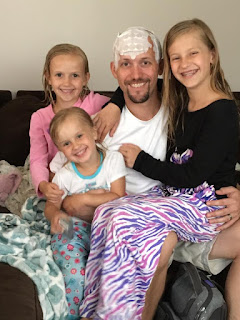 (Eric with his 3 daughters while wearing "Optune" which he wore 23 hours a day for 18 months)
Sara texted me the morning of my interview with The Mother Baby Program, she was supposed to be watching my oldest son that day as well as during the 3 week period I would be attending the program. She said she was sorry that she couldn't watch Brayden anymore, but Eric had a brain tumor. I called her a few times, but we never spoke that day. Her family of 5 had suddenly been thrown into a nightmare that is hard to comprehend. Her strong, smart husband who was the sole breadwinner for them and their 3 small girls had just been given a diagnosis that would take anyone's breath away.
 (Eric and Sara after his first surgery)
8 days after Eric found out he had a the brain tumor, it was surgically removed. They didn't find out exactly what it was right away, but eventually they were told that it was stage 3 brain cancer. They had removed most of it and he would go through chemo and radiation to try and get rid of the remainder of it. For months we watched as the entire Utes family banded together to support Eric. We watched as they stayed strong for their girls and showed each other the true meaning of love. We watched as Eric (amazingly) returned to work pretty quickly after surgery. We saw the kindness of friends and strangers as meals and money were donated to help the family. We saw some of the best in people during the most unfair of life's circumstances.
We watched a strong man in his early 30s get diagnosed with a disease that swept us all off our feet. I saw my friend stay strong for her family, while at times silently struggling inside. I saw my neighbors cry, fearing the unknown. I saw myself, so wrapped up in my illness, not really able to help my friend like I wish I could have.
I've told my (old) neighbors many times since then that I fully believe we lived next to each other for those specific 4 years for a reason. I believe that God put us together because he knew we would need each other during those years. I don't know how I would have survived without Bridget and Sara during that time, and I hope they would say the same thing about me. There were times where we just stood in silence watching our kids play. There were moments where things "felt" normal, even though we knew that our normal had now changed.
 (3 months after diagnosis)
We all ended up moving away for different reasons last summer, but we all still live within 15 minutes of each other. Sara and I talk every day. Though Eric is currently healthy, he will now have MRI's every 3 months for the rest of his life. He also still goes through difficulties I cannot fathom. He's had some seizures and other setbacks that have been hard for their family. Throughout it all though, they have stayed so strong and positive, many people would never guess how much they have gone through. The Utes are "the people you want to be friends with." Their family looks picture perfect. Their daughters are breathtakingly beautiful, but also unbelievably smart. Even though their family has been through so much, Sara still feels guilty every time they can't help out when they said they would or feels bad if she has a bad day.
Sometimes, I wish that Eric and Sara could see themselves like me and my family see them. They are kind beyond words, unconditionally selfless, laugh until you pee funny, never give up kind of people. The relief that they get each time Eric has a clean MRI is always eventually overshadowed by the fact that statistics say it will most likely reoccur-and at a higher grade. People with Eric's diagnosis have a prognosis of living about 3-5 years after being diagnosed. Even when they get "good" news, their new reality is that this is something that they will (likely) be dealing with forever. Please keep this family in your thoughts and prayers, from the bottom of my heart, they are the most amazing people I know.
Next weekend, our family will be participating in the BT5K (Brain Tumor 5K)in the Twin Cities (MN) on the "Utes Crew." It would mean the world to us if as many people as possible donate and participate in this cause. Please consider visiting http://hope.abta.org and supporting brain cancer research. You can also "follow" Eric's story by "liking" Eric's Updates on Facebook. Thank you so much for reading!
In 2012, we bought our first house. On the day that we moved in, the people 2 houses down moved into their house too. Eventually, us and the house in between us became really close. The first two summers were awesome and carefree, but the second autumn is when our relationships went from close neighbors who enjoyed bonfires and grilling cheddar dogs and turned us into lifelong friends.

Sara texted me the morning of my interview with The Mother Baby Program, she was supposed to be watching my oldest son that day as well as during the 3 week period I would be attending the program. She said she was sorry that she couldn't watch Brayden anymore, but Eric had a brain tumor. I called her a few times, but we never spoke that day. Her family of 5 had suddenly been thrown into a nightmare that is hard to comprehend. Her strong, smart husband who was the sole breadwinner for them and their 3 small girls had just been given a diagnosis that would take anyone's breath away.

8 days after Eric found out he had a the brain tumor, it was surgically removed. They didn't find out exactly what it was right away, but eventually they were told that it was stage 3 brain cancer. They had removed most of it and he would go through chemo and radiation to try and get rid of the remainder of it. For months we watched as the entire Utes family banded together to support Eric. We watched as they stayed strong for their girls and showed each other the true meaning of love. We watched as Eric (amazingly) returned to work pretty quickly after surgery. We saw the kindness of friends and strangers as meals and money were donated to help the family. We saw some of the best in people during the most unfair of life's circumstances.
We watched a strong man in his early 30s get diagnosed with a disease that swept us all off our feet. I saw my friend stay strong for her family, while at times silently struggling inside. I saw my neighbors cry, fearing the unknown. I saw myself, so wrapped up in my illness, not really able to help my friend like I wish I could have.
I've told my (old) neighbors many times since then that I fully believe we lived next to each other for those specific 4 years for a reason. I believe that God put us together because he knew we would need each other during those years. I don't know how I would have survived without Bridget and Sara during that time, and I hope they would say the same thing about me. There were times where we just stood in silence watching our kids play. There were moments where things "felt" normal, even though we knew that our normal had now changed.

We all ended up moving away for different reasons last summer, but we all still live within 15 minutes of each other. Sara and I talk every day. Though Eric is currently healthy, he will now have MRI's every 3 months for the rest of his life. He also still goes through difficulties I cannot fathom. He's had some seizures and other setbacks that have been hard for their family. Throughout it all though, they have stayed so strong and positive, many people would never guess how much they have gone through. The Utes are "the people you want to be friends with." Their family looks picture perfect. Their daughters are breathtakingly beautiful, but also unbelievably smart. Even though their family has been through so much, Sara still feels guilty every time they can't help out when they said they would or feels bad if she has a bad day.
Sometimes, I wish that Eric and Sara could see themselves like me and my family see them. They are kind beyond words, unconditionally selfless, laugh until you pee funny, never give up kind of people. The relief that they get each time Eric has a clean MRI is always eventually overshadowed by the fact that statistics say it will most likely reoccur-and at a higher grade. People with Eric's diagnosis have a prognosis of living about 3-5 years after being diagnosed. Even when they get "good" news, their new reality is that this is something that they will (likely) be dealing with forever. Please keep this family in your thoughts and prayers, from the bottom of my heart, they are the most amazing people I know.
Next weekend, our family will be participating in the BT5K (Brain Tumor 5K)in the Twin Cities (MN) on the "Utes Crew." It would mean the world to us if as many people as possible donate and participate in this cause. Please consider visiting http://hope.abta.org and supporting brain cancer research. You can also "follow" Eric's story by "liking" Eric's Updates on Facebook. Thank you so much for reading!
Wednesday, September 13, 2017
Postpartum Depression Isn't Shattered Glass, It's a Puzzle Whose Pieces Will Fit Back Together
Shattered.
Broken.
Lost.
That's how I felt, that's what I had become. Postpartum depression wasn't just being sad. The anxiety I developed didn't revolve around small fears. OCD didn't present itself in a funny way. It was raw, all of it.
The overwhelming sadness I felt took my breath away. At times I thought would never be able to inhale deeply again. The anxiety was crippling. Small fears I had never even recognized suddenly became unscalable mountains. The obsessiveness attached to my fears was beyond my control. I couldn't stop the thoughts. My need to obsess over the thoughts and search for meaning behind them became automatic and unrelenting.
I didn't have a "safe space." When your mind is sick, there isn't anywhere to run. There's no refuge from the storm. There's no quiet place to assess and recharge. There's only deafening thoughts. Constant chaos. Debilitating fear.
I felt broken. Shattered. Ruined.
There was no escape. I felt like nothing could ever fix me. I physically couldn't stop the thoughts, so how would I ever overcome them?
I was so scared. What if the only way to stop the thoughts was to act on them? At one point, the only way I could calm down enough to go to sleep was to tell myself I would hurt myself before I ever hurt my kids. That isn't a healthy way to think or behave, but it's where I was. It was my reality.
I wasn't shattered though, I was just an incomplete puzzle. I had to seek out the pieces and help that I needed in order to be whole again. Recovery was a lot of trial and error. I tried things that didn't work and became discouraged. I found things that did work and had hope. I became impatient with recovery and backslid. I saw how far I'd come and vowed to keep going.
When my life hit the fan, I was brought to my knees. I would have given anything to make it stop, but the exact thing that I felt would somehow kill me gave me an amazing amount of strength once I overcame it. Not only did postpartum depression not shatter me, it made me better. The thing that I didn't believe I would ever recover from is the very thing that made me a better person today. I wasn't a bad person before, but the amount I have grown and changed since experiencing it is only something that would have happened if I went through it.
Without the dark times, it is hard to see the brightness of the good times. If I hadn't suffered so long and hard, I would have never understood others who do. I couldn't have developed the compassion for those with mental illness unless I had experienced it. I would never have believed so strongly in breaking down stigmas attached to mental illness and medications/therapy needed to treat people with them.
Before postpartum depression, I thought I "wasn't the type of person" who would ever need therapy. I was fine. I didn't need medication, I had a brain with complete control over my thoughts and emotions. None of that was true though. We are all flawed. Everyone has their own "Everest" in life. There are all things we don't think we are strong enough to overcome, only to come out the other side with greater understanding and the courage to help others.
To those that much is given, much is expected. I have been given the gift of healing from postpartum depression. I promised myself and God that if I made it through, I would help others. It took more work than I ever realized and greater faith than I knew I had, but I did come out the other side. I want other people to see how far my rock bottom was, not to discourage them, but to show how completely hopeless I was (and how far I've come).
I don't want others to let postpartum depression, anxiety, and OCD shatter them. All is not lost. There is help and hope. Once you heal and the puzzle is complete, you will see that the new, complete person you've become outshines the person that you were before.
Chels
Broken.
Lost.
That's how I felt, that's what I had become. Postpartum depression wasn't just being sad. The anxiety I developed didn't revolve around small fears. OCD didn't present itself in a funny way. It was raw, all of it.
The overwhelming sadness I felt took my breath away. At times I thought would never be able to inhale deeply again. The anxiety was crippling. Small fears I had never even recognized suddenly became unscalable mountains. The obsessiveness attached to my fears was beyond my control. I couldn't stop the thoughts. My need to obsess over the thoughts and search for meaning behind them became automatic and unrelenting.
I didn't have a "safe space." When your mind is sick, there isn't anywhere to run. There's no refuge from the storm. There's no quiet place to assess and recharge. There's only deafening thoughts. Constant chaos. Debilitating fear.
I felt broken. Shattered. Ruined.
There was no escape. I felt like nothing could ever fix me. I physically couldn't stop the thoughts, so how would I ever overcome them?
I was so scared. What if the only way to stop the thoughts was to act on them? At one point, the only way I could calm down enough to go to sleep was to tell myself I would hurt myself before I ever hurt my kids. That isn't a healthy way to think or behave, but it's where I was. It was my reality.
I wasn't shattered though, I was just an incomplete puzzle. I had to seek out the pieces and help that I needed in order to be whole again. Recovery was a lot of trial and error. I tried things that didn't work and became discouraged. I found things that did work and had hope. I became impatient with recovery and backslid. I saw how far I'd come and vowed to keep going.
When my life hit the fan, I was brought to my knees. I would have given anything to make it stop, but the exact thing that I felt would somehow kill me gave me an amazing amount of strength once I overcame it. Not only did postpartum depression not shatter me, it made me better. The thing that I didn't believe I would ever recover from is the very thing that made me a better person today. I wasn't a bad person before, but the amount I have grown and changed since experiencing it is only something that would have happened if I went through it.
Without the dark times, it is hard to see the brightness of the good times. If I hadn't suffered so long and hard, I would have never understood others who do. I couldn't have developed the compassion for those with mental illness unless I had experienced it. I would never have believed so strongly in breaking down stigmas attached to mental illness and medications/therapy needed to treat people with them.
Before postpartum depression, I thought I "wasn't the type of person" who would ever need therapy. I was fine. I didn't need medication, I had a brain with complete control over my thoughts and emotions. None of that was true though. We are all flawed. Everyone has their own "Everest" in life. There are all things we don't think we are strong enough to overcome, only to come out the other side with greater understanding and the courage to help others.
To those that much is given, much is expected. I have been given the gift of healing from postpartum depression. I promised myself and God that if I made it through, I would help others. It took more work than I ever realized and greater faith than I knew I had, but I did come out the other side. I want other people to see how far my rock bottom was, not to discourage them, but to show how completely hopeless I was (and how far I've come).
I don't want others to let postpartum depression, anxiety, and OCD shatter them. All is not lost. There is help and hope. Once you heal and the puzzle is complete, you will see that the new, complete person you've become outshines the person that you were before.
Chels
Wednesday, September 6, 2017
The 1 Thing I Needed in Order to Let Go of My OCD
My OCD.
My mental illness.
My disorder.
My greatest enemy.
My constant companion.
How could I let go of the thoughts? They were dangerous, out of control.
I needed to control them, I needed to continue having them in order to make sure my kids were okay. At first, I kind of had the thoughts knowingly, consciously. I would read blogs and find new fears. I began to develop the fears of other women I read about. The fact that bad things still gave me anxiety meant, in a twisted way, that I would be okay. If the thoughts still scared me, I wasn't psychotic. Eventually however, I had the thoughts automatically, it was completely out of my control.
Every minute of the day was consumed with thoughts and worry. I had gone from never having a threatening thought in my life, to having them constantly...about my children.
I was scared. Terrified. Within 1 month I had completely forgotten my former self.
What did I used to think about?
How did I used to act?
Did I really I love motherhood?
What if this was permanent?
I hung onto the thoughts for a long time, or rather, I hung on to the anxiety that propelled them. For months, I felt the need to keep worrying about the thoughts. It felt like some sort of moral requirement that I needed to spend the rest of my life remembering and repaying for the thoughts. For me, thought=action. I saw no difference. If I could think it, I obviously was capable of doing it. More than that, if I could think it, I wanted to do it.
I couldn't figure out how it was possible to have completely zero control over my thoughts. If I kept thinking about something, I must want to, there was no other answer.
Therapists told me over and over that analyzing the thoughts only furthered my illness, but I just couldn't seem to let go of it all.
In order for me to let go of OCD, I needed to know that the thoughts weren't the real me. Until I became completely convinced that they were 100% a symptom of a disease, I (felt) that I couldn't risk letting them go.
Letting them go meant letting them do what they wanted, without reaction. I had to let them say what they wanted without letting myself get beat down by them. I needed to take my power back from them. When I thought something awful about my kids, I wanted to fight it. I wanted to fight the thought, find the cause of it, then make myself pay an emotional price for having it. But to overcome it, I had to stop.
In order to conquer it, you have to understand that it is all based on a lie. Anxiety lies to you, it finds threats in the mundane. OCD turns these lies into obsessions. The obsessiveness is exhausting. The exhaustion eats away at rationality. The sadness it causes dims the soul.
So, you may be asking, how does someone let their OCD go? Set it free.
I understand that "setting it free" sounds simple, but feels impossible. I get it. It's like saying "dunking a basketball is simple, just jump high." Letting go of anxiety and OCD takes dedication and determination. Some days you won't feel strong enough, that's okay. Other days you will feel like you can conquer the world, that's awesome. Though emotions differ from day to day, one thing needs to stay the same: your goal.
The goal is wellness, not perfection. No one is perfect, everyone has good and bad days. Recovery doesn't happen overnight, but that doesn't mean it is unachievable. The same energy that once went in to deciphering and dissecting the thoughts now needs to go into self-care and rebuilding self-esteem.
In order to recover, I needed to start believing in myself again. I needed to believe what my friends and family were telling me. I needed to stop fearing the future and take control of my present. I needed to rediscover myself and trust in me again.
OCD and anxiety lie. The thoughts they put in my head weren't the true "me" and they aren't true for others who suffer either. We aren't a collection of sinister people who are flying under the radar, putting those in our presence in danger. We are highly sensitive individuals who gave a bad thought too much power. That's it, I promise.
My mental illness.
My disorder.
My greatest enemy.
My constant companion.
How could I let go of the thoughts? They were dangerous, out of control.
I needed to control them, I needed to continue having them in order to make sure my kids were okay. At first, I kind of had the thoughts knowingly, consciously. I would read blogs and find new fears. I began to develop the fears of other women I read about. The fact that bad things still gave me anxiety meant, in a twisted way, that I would be okay. If the thoughts still scared me, I wasn't psychotic. Eventually however, I had the thoughts automatically, it was completely out of my control.
Every minute of the day was consumed with thoughts and worry. I had gone from never having a threatening thought in my life, to having them constantly...about my children.
I was scared. Terrified. Within 1 month I had completely forgotten my former self.
What did I used to think about?
How did I used to act?
Did I really I love motherhood?
What if this was permanent?
I hung onto the thoughts for a long time, or rather, I hung on to the anxiety that propelled them. For months, I felt the need to keep worrying about the thoughts. It felt like some sort of moral requirement that I needed to spend the rest of my life remembering and repaying for the thoughts. For me, thought=action. I saw no difference. If I could think it, I obviously was capable of doing it. More than that, if I could think it, I wanted to do it.
I couldn't figure out how it was possible to have completely zero control over my thoughts. If I kept thinking about something, I must want to, there was no other answer.
Therapists told me over and over that analyzing the thoughts only furthered my illness, but I just couldn't seem to let go of it all.
In order for me to let go of OCD, I needed to know that the thoughts weren't the real me. Until I became completely convinced that they were 100% a symptom of a disease, I (felt) that I couldn't risk letting them go.
Letting them go meant letting them do what they wanted, without reaction. I had to let them say what they wanted without letting myself get beat down by them. I needed to take my power back from them. When I thought something awful about my kids, I wanted to fight it. I wanted to fight the thought, find the cause of it, then make myself pay an emotional price for having it. But to overcome it, I had to stop.
In order to conquer it, you have to understand that it is all based on a lie. Anxiety lies to you, it finds threats in the mundane. OCD turns these lies into obsessions. The obsessiveness is exhausting. The exhaustion eats away at rationality. The sadness it causes dims the soul.
So, you may be asking, how does someone let their OCD go? Set it free.
I understand that "setting it free" sounds simple, but feels impossible. I get it. It's like saying "dunking a basketball is simple, just jump high." Letting go of anxiety and OCD takes dedication and determination. Some days you won't feel strong enough, that's okay. Other days you will feel like you can conquer the world, that's awesome. Though emotions differ from day to day, one thing needs to stay the same: your goal.
The goal is wellness, not perfection. No one is perfect, everyone has good and bad days. Recovery doesn't happen overnight, but that doesn't mean it is unachievable. The same energy that once went in to deciphering and dissecting the thoughts now needs to go into self-care and rebuilding self-esteem.
In order to recover, I needed to start believing in myself again. I needed to believe what my friends and family were telling me. I needed to stop fearing the future and take control of my present. I needed to rediscover myself and trust in me again.
OCD and anxiety lie. The thoughts they put in my head weren't the true "me" and they aren't true for others who suffer either. We aren't a collection of sinister people who are flying under the radar, putting those in our presence in danger. We are highly sensitive individuals who gave a bad thought too much power. That's it, I promise.
Saturday, July 8, 2017
Happy Birthday to the Baby I Fought For
Three years ago on June 23, I was celebrating the birth of my second son, Easton. He's been perfection since the start, his eyes sparkle and he is an amazing blend of his daddy and I. We were smitten, over the moon, but once the OCD set in my single greatest fear was this: how will our relationship ever recover?
What if he hates me for my disease?
What if he can't forgive the thoughts?
What if I can't?
What if I refuse to?

The fear became all-consuming. There was a fight on all fronts, the battle in my mind was unbearable, but almost equally as painful was the constant feeling of disappointing my boys. Physically, I didn't miss a moment of their lives, but emotionally I was distant. The distance felt like miles, the months I kept them at arm's length seemed infinite. One of my first questions in therapy was: is he going to hate me?
Hate. Will he HATE me?
He grew inside of me.
For 9 months I was his cocoon, his home.
I now feared that I had crossed some invisible line of trust that he would never be able to forgive.
I thought that no matter what I did, I had already ruined me.
I'd ruined us.
But then my therapist told me something I've taken with me to this day, she said that if anything, our connection would be stronger.
Stronger. I didn't think that was possible. I felt like the lowest of low. It felt like I was secretly hurting my kids, so I had to constantly make up for it. I thought that the more often I had a scary thought, the more likely it was for me to act on it. I thought the longer it took me to recover, the greater chance it reflected my true character. How could he ever be closer to me even after everything that had happened?
About 3 months into my postpartum OCD journey, I truly felt like I had weaved myself into some sort of web that I would never be able to get out of. I was at the bottom a well and there was no rope long enough to pull me out with. I was thrashing in the water, grasping for breath. I was hopeless.
But slowly, ever so slowly, I clawed my way out.
Every parent fights for their child. Every parent has different experiences with each baby, but for me, I feel like Easton is truly the baby I fought for.
I've had 3 babies:
Brayden was my first born and he made me a mother. He opened my eyes to caring about another human more than myself. He taught me to be nurturing and safe, he gave my heart a new softness it hadn't had before.
Easton rocked my world. Caring for him scared me. Touching him made me want to jump out of my skin. My heart raced when I knew we would be alone, I could not relax around him. The fear I felt completely overshadowed my ability to feel the closeness to him that I longed for. Anxiety spent months lying to me and scaring me to death, but we persevered. I was eventually able to decipher my anxious thoughts from my real ones. I was able to calm down and believe that the OCD really was my mind malfunctioning in a constant attempt to keep Easton safe.
Easton was the baby I fought for. I fought for every cuddle and kiss. Every laugh and snuggle. I fought for him to love me and trust me. I put myself through hell in order to keep him safe. I cried more tears than should be allotted in a lifetime and discovered parts of myself that I had never known existed. OCD felt like an identity crisis. I felt like a stranger within my own body. I felt out of place in my own mind, like an unwelcomed guest that didn't know where to put their bags. But eventually, everything clicked.
Easton has the ability to put everyone at ease. His mischievous smile and innocent eyes make it impossible not to love him. I'm sure this is true for a lot of moms, but Easton was my biggest therapy. He healed me. When I was losing my mind in guilt and anguish, he was growing, thriving. In spite of my struggles, I was able to continue raising my children and loving them. I know I would have made it through OCD no matter what baby it was with, but I truly feel like God gave me Easton to conquer this struggle together.
After Easton came Ella. Ella was my redemption baby. She was the one who I got pregnant with even though I didn't have full trust back within myself. Having her was a leap of faith, something that I swore to myself at one point would never happen. When Ella was born, I was like a watchman, searching for problems. Waiting to lose my mind, but I didn't. I was stable. I was secure in my character. I knew the lies that anxiety and depression wanted me to believe and was able to combat them before they made a nest in my brain. Everything that had happened with my previous baby was something that I knew to look out for and properly fight against.
Easton's birthday isn't about me, it's about the birth of an amazing boy, but it will always mark a time in my life where a major crisis occurred. The war in my mind following Easton's birth felt very life or death. The realness of the fear is something that I had never experienced before and honestly, could never have understood without having been through it.
Each of my children are a blessing, we each have a special bond, but Easton has changed the trajectory of my life. My perspective on love and relationships has changed. My ability to have empathy for others has expanded in a way that I wouldn't have expected. My perception of people with mental health issues has transformed. The way I view the use of medications has shifted. Almost every aspect of my womanhood and motherhood has changed because of postpartum OCD. It was an exhausting tug of war that happened exclusively in my mind, but created a lifetime's worth of change within me. I'm stronger than I knew. I'm softer than I was.
I hate postpartum OCD, anxiety, and depression with every fiber of my being, which is why it is so important for me to help other woman with it. It isn't fair. It isn't easy. It isn't your fault. But it IS something you can overcome.
So, 3 weeks late, happy birthday, Easton. I love and cherish you. I'm blessed to have been given you to get me through that dark time. I'm eternally grateful for the mommy you have helped me become.
Chels
What if he hates me for my disease?
What if he can't forgive the thoughts?
What if I can't?
What if I refuse to?

The fear became all-consuming. There was a fight on all fronts, the battle in my mind was unbearable, but almost equally as painful was the constant feeling of disappointing my boys. Physically, I didn't miss a moment of their lives, but emotionally I was distant. The distance felt like miles, the months I kept them at arm's length seemed infinite. One of my first questions in therapy was: is he going to hate me?
Hate. Will he HATE me?
He grew inside of me.
For 9 months I was his cocoon, his home.
I now feared that I had crossed some invisible line of trust that he would never be able to forgive.
I thought that no matter what I did, I had already ruined me.
I'd ruined us.
But then my therapist told me something I've taken with me to this day, she said that if anything, our connection would be stronger.
Stronger. I didn't think that was possible. I felt like the lowest of low. It felt like I was secretly hurting my kids, so I had to constantly make up for it. I thought that the more often I had a scary thought, the more likely it was for me to act on it. I thought the longer it took me to recover, the greater chance it reflected my true character. How could he ever be closer to me even after everything that had happened?
About 3 months into my postpartum OCD journey, I truly felt like I had weaved myself into some sort of web that I would never be able to get out of. I was at the bottom a well and there was no rope long enough to pull me out with. I was thrashing in the water, grasping for breath. I was hopeless.
But slowly, ever so slowly, I clawed my way out.
Every parent fights for their child. Every parent has different experiences with each baby, but for me, I feel like Easton is truly the baby I fought for.
I've had 3 babies:
Brayden was my first born and he made me a mother. He opened my eyes to caring about another human more than myself. He taught me to be nurturing and safe, he gave my heart a new softness it hadn't had before.
Easton rocked my world. Caring for him scared me. Touching him made me want to jump out of my skin. My heart raced when I knew we would be alone, I could not relax around him. The fear I felt completely overshadowed my ability to feel the closeness to him that I longed for. Anxiety spent months lying to me and scaring me to death, but we persevered. I was eventually able to decipher my anxious thoughts from my real ones. I was able to calm down and believe that the OCD really was my mind malfunctioning in a constant attempt to keep Easton safe.
Easton was the baby I fought for. I fought for every cuddle and kiss. Every laugh and snuggle. I fought for him to love me and trust me. I put myself through hell in order to keep him safe. I cried more tears than should be allotted in a lifetime and discovered parts of myself that I had never known existed. OCD felt like an identity crisis. I felt like a stranger within my own body. I felt out of place in my own mind, like an unwelcomed guest that didn't know where to put their bags. But eventually, everything clicked.
Easton has the ability to put everyone at ease. His mischievous smile and innocent eyes make it impossible not to love him. I'm sure this is true for a lot of moms, but Easton was my biggest therapy. He healed me. When I was losing my mind in guilt and anguish, he was growing, thriving. In spite of my struggles, I was able to continue raising my children and loving them. I know I would have made it through OCD no matter what baby it was with, but I truly feel like God gave me Easton to conquer this struggle together.
After Easton came Ella. Ella was my redemption baby. She was the one who I got pregnant with even though I didn't have full trust back within myself. Having her was a leap of faith, something that I swore to myself at one point would never happen. When Ella was born, I was like a watchman, searching for problems. Waiting to lose my mind, but I didn't. I was stable. I was secure in my character. I knew the lies that anxiety and depression wanted me to believe and was able to combat them before they made a nest in my brain. Everything that had happened with my previous baby was something that I knew to look out for and properly fight against.
Easton's birthday isn't about me, it's about the birth of an amazing boy, but it will always mark a time in my life where a major crisis occurred. The war in my mind following Easton's birth felt very life or death. The realness of the fear is something that I had never experienced before and honestly, could never have understood without having been through it.
Each of my children are a blessing, we each have a special bond, but Easton has changed the trajectory of my life. My perspective on love and relationships has changed. My ability to have empathy for others has expanded in a way that I wouldn't have expected. My perception of people with mental health issues has transformed. The way I view the use of medications has shifted. Almost every aspect of my womanhood and motherhood has changed because of postpartum OCD. It was an exhausting tug of war that happened exclusively in my mind, but created a lifetime's worth of change within me. I'm stronger than I knew. I'm softer than I was.
I hate postpartum OCD, anxiety, and depression with every fiber of my being, which is why it is so important for me to help other woman with it. It isn't fair. It isn't easy. It isn't your fault. But it IS something you can overcome.
So, 3 weeks late, happy birthday, Easton. I love and cherish you. I'm blessed to have been given you to get me through that dark time. I'm eternally grateful for the mommy you have helped me become.
Chels
Thursday, June 1, 2017
5 Small Comforts Amidst the Chaos of Postpartum OCD
Happy Spring (Summer?)
I completely understand how frustrating it may be to follow a blogger who is MIA, and I'm sorry. January-May are the months every year where my family is in "survival mode." My husband is home an average of 1 day a week and this was my first year with all 3. First, I want to say that, although my husband and I are exhausted, this year has been amazing! When I first started writing again I was scared...actually, terrified. I wanted to document my journey past OCD, but was also kind of fearful of it coming back. What if I turned into that girl again. What if I struggled. What if I backslid.
I didn't.
Recently I was telling a friend of mine how much I love Ella (my 9 month old). I couldn't believe how freely I've enjoyed her, because it was the exact opposite of my postpartum experience with my second child. My friend said "you're smitten." Smitten. Yes, I'm EXACTLY that. I've treaded lightly and kept my eyes open for trouble, but it never showed up. I've stayed on medication and am in contact with my therapist. If I were to run into trouble, I would have the tools at my fingertips to get better quickly.

Since this is a safe place and honesty is my policy, my blog doesn't "look" like I want it to. It's like I have things to say, but I haven't yet found the time to make my blog my own, which is something I'm going to focus on before the new year (see how I put a nice long timeline on that ; )). My page will become beautiful and professional, but for now what is most important to me is to have these words written down. Women who need support don't care about what font I use, but they do need somewhere to go for reassurance and encouragement and that's what I'm aiming to accomplish right now.
When I was suffering through OCD and was in the "thick of it" I spent about 95% of my time on Google looking for symptoms, stories, and reassurance. I needed to find someone who had been in my shoes. I needed to know that they had every single symptom that I did, and I needed to know that they had ended up okay. I would sometimes find specific articles or websites that would explain so perfectly what I was going through that I would regularly look them up to calm myself down. The relatability of the words would bring me to tears. Knowing I wasn't alone was comforting.
I regularly get messages from women who are struggling. I'm not a professional, but I'm a woman who has been through something hard and can encourage others who are currently struggling. Many people who contact me have the same questions, so I thought it might be helpful to write out some things about my experience that may be helpful to hear or look at when struggling.
1. When people say "please, reach out for help" or "you must get help" they aren't saying it to scare you or imply that you are dangerous. You deserve help and peace. You deserve to be happy and healthy. You do need to get help, I NEEDED to get help, not because I was a danger to myself or my children, but because I didn't need to struggle. I didn't need to feel isolated and scared. My children needed their fun, vibrant mommy back instead of the shell I had become. So, YES, please get help. It is so important to get help and be diagnosed properly, I would recommend connecting with Postpartum Support International (1.800.944.4773) in order to be matched with skilled professional in your area. Yes, I had scary thoughts. Yes, I got help. No, my children were never taken from me, not for a second.
2. The content of your (intrusive) thoughts have nothing to do with how much you love your baby (babies). When getting help, professionals aren't necessarily looking at the content of the specific thoughts, it is your reaction to them. If you have a scary thought and are terrified by it, you are not psychotic. Having physical reactions (sweating, crying, weight loss, etc) are all possible reactions to scary thoughts. If you are seeing a professional who understands OCD (especially if they're one that I went to haha) they've heard EVERYTHING, I promise : ). Thinking about hurting someone is NOT the same as wanting to hurt them or actually hurting them. The obsessiveness sets in when you try to figure out why you had the thought. You are so disturbed by it that you must examine the thought or examine your entire life to decide whether you agree with the thought or not. OCD forces you to agonize over thoughts that don't deserve it. If you are worrying about hurting someone, it means you love them, please don't dig deeper for meaning, there will never be one.
3. You will not just "snap" someday. People with OCD are very careful with their actions. They drive themselves crazy, but their actions are very calculated. I knew every inch of every movement that I made for over a year, analyzing each move for whether I had touched or done something in a way that I perceived to be dangerous. You will not snap or act out, if anything, when I was suffering I was more gentle and accommodating to my children because I felt that I had to "make up for" all of the terrible things I was constantly thinking.
4. Being unable to stop the thoughts will never translate into you agreeing with them. Ever. I used to think that if I couldn't stop the thoughts, at some point I would begin agreeing with them. I also feared that at some point I would get so fed up with having them that I would act on them as a last resort. Neither of those did or would ever happen. Intrusive thoughts are against everything the sufferer's soul believes in. You are a good person, which is why this affecting you to your core. The repetitiveness of the thoughts will never translate into you believing in them, you will also never become so beat down by them that you will listen to them. This illness is HARD. Intense. Overwhelming. I promise, you can overcome it!
5. Instead of looking for any similarities between yourself and any story you have ever heard of someone hurting another person, look for differences. Or don't look at all. You are not them, you are on your own journey, please focus on that. It can be so easy to be distracted by what someone else did who may "seem" to be on the same journey as you, but they aren't you. You have control over yourself and your destiny, please focus on making the life for you and your children as good as possible.
I hope some of these things are encouraging for women who are currently struggling. These were things that I needed to hear when I was having a hard time, I hope that this article is one that can be looked at during hard times when reassurance is needed.
Thanks for reading!
Chels
I completely understand how frustrating it may be to follow a blogger who is MIA, and I'm sorry. January-May are the months every year where my family is in "survival mode." My husband is home an average of 1 day a week and this was my first year with all 3. First, I want to say that, although my husband and I are exhausted, this year has been amazing! When I first started writing again I was scared...actually, terrified. I wanted to document my journey past OCD, but was also kind of fearful of it coming back. What if I turned into that girl again. What if I struggled. What if I backslid.
I didn't.
Recently I was telling a friend of mine how much I love Ella (my 9 month old). I couldn't believe how freely I've enjoyed her, because it was the exact opposite of my postpartum experience with my second child. My friend said "you're smitten." Smitten. Yes, I'm EXACTLY that. I've treaded lightly and kept my eyes open for trouble, but it never showed up. I've stayed on medication and am in contact with my therapist. If I were to run into trouble, I would have the tools at my fingertips to get better quickly.

Since this is a safe place and honesty is my policy, my blog doesn't "look" like I want it to. It's like I have things to say, but I haven't yet found the time to make my blog my own, which is something I'm going to focus on before the new year (see how I put a nice long timeline on that ; )). My page will become beautiful and professional, but for now what is most important to me is to have these words written down. Women who need support don't care about what font I use, but they do need somewhere to go for reassurance and encouragement and that's what I'm aiming to accomplish right now.
When I was suffering through OCD and was in the "thick of it" I spent about 95% of my time on Google looking for symptoms, stories, and reassurance. I needed to find someone who had been in my shoes. I needed to know that they had every single symptom that I did, and I needed to know that they had ended up okay. I would sometimes find specific articles or websites that would explain so perfectly what I was going through that I would regularly look them up to calm myself down. The relatability of the words would bring me to tears. Knowing I wasn't alone was comforting.
I regularly get messages from women who are struggling. I'm not a professional, but I'm a woman who has been through something hard and can encourage others who are currently struggling. Many people who contact me have the same questions, so I thought it might be helpful to write out some things about my experience that may be helpful to hear or look at when struggling.
1. When people say "please, reach out for help" or "you must get help" they aren't saying it to scare you or imply that you are dangerous. You deserve help and peace. You deserve to be happy and healthy. You do need to get help, I NEEDED to get help, not because I was a danger to myself or my children, but because I didn't need to struggle. I didn't need to feel isolated and scared. My children needed their fun, vibrant mommy back instead of the shell I had become. So, YES, please get help. It is so important to get help and be diagnosed properly, I would recommend connecting with Postpartum Support International (1.800.944.4773) in order to be matched with skilled professional in your area. Yes, I had scary thoughts. Yes, I got help. No, my children were never taken from me, not for a second.
2. The content of your (intrusive) thoughts have nothing to do with how much you love your baby (babies). When getting help, professionals aren't necessarily looking at the content of the specific thoughts, it is your reaction to them. If you have a scary thought and are terrified by it, you are not psychotic. Having physical reactions (sweating, crying, weight loss, etc) are all possible reactions to scary thoughts. If you are seeing a professional who understands OCD (especially if they're one that I went to haha) they've heard EVERYTHING, I promise : ). Thinking about hurting someone is NOT the same as wanting to hurt them or actually hurting them. The obsessiveness sets in when you try to figure out why you had the thought. You are so disturbed by it that you must examine the thought or examine your entire life to decide whether you agree with the thought or not. OCD forces you to agonize over thoughts that don't deserve it. If you are worrying about hurting someone, it means you love them, please don't dig deeper for meaning, there will never be one.
3. You will not just "snap" someday. People with OCD are very careful with their actions. They drive themselves crazy, but their actions are very calculated. I knew every inch of every movement that I made for over a year, analyzing each move for whether I had touched or done something in a way that I perceived to be dangerous. You will not snap or act out, if anything, when I was suffering I was more gentle and accommodating to my children because I felt that I had to "make up for" all of the terrible things I was constantly thinking.
4. Being unable to stop the thoughts will never translate into you agreeing with them. Ever. I used to think that if I couldn't stop the thoughts, at some point I would begin agreeing with them. I also feared that at some point I would get so fed up with having them that I would act on them as a last resort. Neither of those did or would ever happen. Intrusive thoughts are against everything the sufferer's soul believes in. You are a good person, which is why this affecting you to your core. The repetitiveness of the thoughts will never translate into you believing in them, you will also never become so beat down by them that you will listen to them. This illness is HARD. Intense. Overwhelming. I promise, you can overcome it!
5. Instead of looking for any similarities between yourself and any story you have ever heard of someone hurting another person, look for differences. Or don't look at all. You are not them, you are on your own journey, please focus on that. It can be so easy to be distracted by what someone else did who may "seem" to be on the same journey as you, but they aren't you. You have control over yourself and your destiny, please focus on making the life for you and your children as good as possible.
I hope some of these things are encouraging for women who are currently struggling. These were things that I needed to hear when I was having a hard time, I hope that this article is one that can be looked at during hard times when reassurance is needed.
Thanks for reading!
Chels
Monday, March 6, 2017
How Could This (OCD) Happen to Me?
I had him on purpose.
I wanted him.
I dreamt of him.
I longed for him.
I counted down until the minute he was born, and he came out perfect.
His eyes a stunning blue.
His skin pale olive.
His lips perfection.
He was calm, easy, sweet.
He smelled like lavender and filled me with love, he made our family feel more complete.
He was mine.
And then came the thought.
The thought shattered me. It took everything I had ever known about myself and made me question it.
All of my energy went into the thought.
Nothing else mattered. I needed a reason, I needed to know why I had a thought about hurting him. Without that knowledge I didn't feel like I could go on or let go. I couldn't let myself be irresponsible with my thoughts, that was too dangerous.
OCD crept up on me when I wasn't looking, or perhaps when I was looking too hard.
It took my deepest thoughts and fears and legitimized them.
It took my soul and ravaged it.
It put my brain into permanent overdrive.
In the mirror I looked the same, but on the inside I felt scared. Terrified.
I would have given anything to escape my own body.
How did OCD know? How did it find me? How did I let this happen?
OCD found my soft spots, it preyed on the fact that my heart and soul belonged to a brand new 7lb 5oz being, and it attacked me using my greatest fears as ammunition.
Each thought that put him in danger was mortifying. Unbearable. Unforgivable.
Each time I tried to outthink or outmaneuver OCD, I got beat.
Each time I thought I was doing my best to find help and recover, I realized that I was 1 step behind and I needed more help than I thought.
I thought that obsessing over the thoughts was the right thing.
I thought that focusing on them kept my children safe.
I thought that if I kept proving to myself they were safe, my mind would actually believe it.
I thought I needed to pay the price for the awful things spinning around in my mind.
What I didn't know, was these thoughts were not mine.
OCD took up space in my mind, it gave me anxious thoughts that were not mine, and it used them to scare me.
Conquering OCD meant removing its power over me.
Removing the fear, the anxiety, the pain.
Refusing to let it torment me, to persuade me, to lie to me.
I needed to build myself back up, to pick up the pieces, to forgive (myself).
I needed to be kind, be safe, be loved.
To conquer OCD, you need to be kind to yourself. Feel safe with yourself. Love yourself.
Write your strengths down, review them, believe them. I'll help you start:
OCD wasn't something I did. It wasn't something I asked for or deserved. It was a disease brought on by anxiety and fueled by my overwhelming need to keep my children safe. I wasn't bad for having the first thought, and I wasn't bad for not understanding how to fix it. Reaching out for help is hard, but not impossible. Please, be kind to yourself!
Chels
I wanted him.
I dreamt of him.
I longed for him.
I counted down until the minute he was born, and he came out perfect.
His eyes a stunning blue.
His skin pale olive.
His lips perfection.
He was calm, easy, sweet.
He smelled like lavender and filled me with love, he made our family feel more complete.
He was mine.
And then came the thought.
The thought shattered me. It took everything I had ever known about myself and made me question it.
All of my energy went into the thought.
Nothing else mattered. I needed a reason, I needed to know why I had a thought about hurting him. Without that knowledge I didn't feel like I could go on or let go. I couldn't let myself be irresponsible with my thoughts, that was too dangerous.
OCD crept up on me when I wasn't looking, or perhaps when I was looking too hard.
It took my deepest thoughts and fears and legitimized them.
It took my soul and ravaged it.
It put my brain into permanent overdrive.
In the mirror I looked the same, but on the inside I felt scared. Terrified.
I would have given anything to escape my own body.
How did OCD know? How did it find me? How did I let this happen?
OCD found my soft spots, it preyed on the fact that my heart and soul belonged to a brand new 7lb 5oz being, and it attacked me using my greatest fears as ammunition.
Each thought that put him in danger was mortifying. Unbearable. Unforgivable.
Each time I tried to outthink or outmaneuver OCD, I got beat.
Each time I thought I was doing my best to find help and recover, I realized that I was 1 step behind and I needed more help than I thought.
I thought that obsessing over the thoughts was the right thing.
I thought that focusing on them kept my children safe.
I thought that if I kept proving to myself they were safe, my mind would actually believe it.
I thought I needed to pay the price for the awful things spinning around in my mind.
What I didn't know, was these thoughts were not mine.
OCD took up space in my mind, it gave me anxious thoughts that were not mine, and it used them to scare me.
Conquering OCD meant removing its power over me.
Removing the fear, the anxiety, the pain.
Refusing to let it torment me, to persuade me, to lie to me.
I needed to build myself back up, to pick up the pieces, to forgive (myself).
I needed to be kind, be safe, be loved.
To conquer OCD, you need to be kind to yourself. Feel safe with yourself. Love yourself.
Write your strengths down, review them, believe them. I'll help you start:
- You love deeply. If you didn't, bad thoughts wouldn't bother you.
- You are sensitive. Please don't confuse sensitive with weak, sensitive means your heart is big and you are very aware of your feelings and the feelings of those around you.
- You are brave. I know you're brave because you found this article, you typed words into a search engine that hurt your soul because you knew that you needed help.
- You are strong. You are strong because I've been in your shoes. Anyone who endures OCD, depression, and anxiety is strong beyond words because they are not only dealing with everyday struggles, but they are doing it while struggling on the inside.
- You are loved. Your baby loves you, your family loves you...YOU love you! And if you don't, you need to, because you deserve it.
Use this list or make your own. Write down things that are true about you, your character, your life. When OCD tries to lie to you, tell it to back off. You are strong. You are loved. You are amazing.
OCD wasn't something I did. It wasn't something I asked for or deserved. It was a disease brought on by anxiety and fueled by my overwhelming need to keep my children safe. I wasn't bad for having the first thought, and I wasn't bad for not understanding how to fix it. Reaching out for help is hard, but not impossible. Please, be kind to yourself!
Chels
Monday, February 27, 2017
The Journey of Healing from OCD
Healing, such a small word for such a huge accomplishment.
Healing starts with a moment. One moment in which you realize that you were able to focus on something other than OCD for just a second. That moment gives you a glimmer of hope. A glimmer of normalcy, a glimmer of what life can be again.
That glimmer drives you, it encourages you.
You keep going, keep fighting, keep wishing, keep searching, keep praying for relief. Full recovery seems elusive, but now it is your journey, your mission. The more you try to rush it, the further away it seems. So you keep doing everything you know to get better. Reach out to friends. Ask family for support. Take medication. Go to therapy.
You are a perfectionist following all of the rules put in place for recovery, but why is it taking so long?
Then, when you least expect it, like when you fall in love...it comes. Sweet relief begins to wash over you. The harder days are less hard. The bad days are fewer and farther between. You begin to recognize yourself, the REAL you begins to emerge again.
You slowly begin to build the trust back up with yourself, but you aren't so quick to forgive the brain that betrayed you. The "old you" begins to come back, but it has also transformed.
You are now more wise, more understanding, more aware of yourself and others. You feel deeper and love stronger. Empathy and compassion flow out of you. Every stigma you used to have toward mental illness has become something you now want to help others fight against. You don't take one laugh, one "I love you" or one smile for granted. You've discovered a new side of yourself you never knew existed, a side that might have never been without OCD.
You're different, but very much the same. Laughter comes easily. Beauty can be seen in the littlest things. The darkness that used to rule your life has subsided and you can enjoy the sunshine again. The rollercoaster you've been on for months is over. The uncertainty has disappeared, you now feel safe.
You feel safe with yourself, your children, your life. You can now with full certainty distinguish between the thoughts of OCD and the thoughts are the "true you."
At first you cling to your recovery like a life vest in the ocean. You fear letting go, getting sucked back into the obsessions, the thoughts, the fears. Your new thoughts are calculated and precise. For a while, you may worry that OCD will never truly lose its grip on you, healing takes a huge leap of faith. But I promise, freedom will come. Complete freedom and recovery IS possible.
Recovery from OCD takes time, it doesn't occur overnight. OCD is traumatizing, it takes mental and physical stamina you never knew you had. It takes your mind to agonizing lows and places fear into the most mundane circumstances.
Once you climb out, once recovery is firmly in your grip, you walk. Keep walking and for a while, don't look back. Place distance between yourself and your thoughts, your fears, your obsessions. Enjoy the peace, the love, the serenity. Allow yourself to take a break, a true break. Lay in your bed thoughtless. Play with your children carefree. Laugh so hard it hurts. Enjoy your family. Enjoy your life.
Don't allow OCD to win. Don't let yourself hold a grudge over your journey, learn from it. Learn that these thoughts affected you so much because you love so hard and care so deeply. Learn that you are highly sensitive to right and wrong, and know that it's okay. Learn that you love your children so much, you set up mental and physical barriers to protect them (even if it meant protecting them from you). You sensed danger and you sacrificed your sanity for it, but now you know that you don't have to do that anymore.
You can protect your children in different ways. You can see danger, but don't need to obsess over it. You can have a bad thought, but that doesn't define your character.
OCD wants you to believe you should be small and fear, the truth is you are great and fierce!
Keep fighting mommas, your recovery is in reach!
Chels
Healing starts with a moment. One moment in which you realize that you were able to focus on something other than OCD for just a second. That moment gives you a glimmer of hope. A glimmer of normalcy, a glimmer of what life can be again.
That glimmer drives you, it encourages you.
You keep going, keep fighting, keep wishing, keep searching, keep praying for relief. Full recovery seems elusive, but now it is your journey, your mission. The more you try to rush it, the further away it seems. So you keep doing everything you know to get better. Reach out to friends. Ask family for support. Take medication. Go to therapy.
You are a perfectionist following all of the rules put in place for recovery, but why is it taking so long?
Then, when you least expect it, like when you fall in love...it comes. Sweet relief begins to wash over you. The harder days are less hard. The bad days are fewer and farther between. You begin to recognize yourself, the REAL you begins to emerge again.
You slowly begin to build the trust back up with yourself, but you aren't so quick to forgive the brain that betrayed you. The "old you" begins to come back, but it has also transformed.
You are now more wise, more understanding, more aware of yourself and others. You feel deeper and love stronger. Empathy and compassion flow out of you. Every stigma you used to have toward mental illness has become something you now want to help others fight against. You don't take one laugh, one "I love you" or one smile for granted. You've discovered a new side of yourself you never knew existed, a side that might have never been without OCD.
You're different, but very much the same. Laughter comes easily. Beauty can be seen in the littlest things. The darkness that used to rule your life has subsided and you can enjoy the sunshine again. The rollercoaster you've been on for months is over. The uncertainty has disappeared, you now feel safe.
You feel safe with yourself, your children, your life. You can now with full certainty distinguish between the thoughts of OCD and the thoughts are the "true you."
At first you cling to your recovery like a life vest in the ocean. You fear letting go, getting sucked back into the obsessions, the thoughts, the fears. Your new thoughts are calculated and precise. For a while, you may worry that OCD will never truly lose its grip on you, healing takes a huge leap of faith. But I promise, freedom will come. Complete freedom and recovery IS possible.
Recovery from OCD takes time, it doesn't occur overnight. OCD is traumatizing, it takes mental and physical stamina you never knew you had. It takes your mind to agonizing lows and places fear into the most mundane circumstances.
Once you climb out, once recovery is firmly in your grip, you walk. Keep walking and for a while, don't look back. Place distance between yourself and your thoughts, your fears, your obsessions. Enjoy the peace, the love, the serenity. Allow yourself to take a break, a true break. Lay in your bed thoughtless. Play with your children carefree. Laugh so hard it hurts. Enjoy your family. Enjoy your life.
Don't allow OCD to win. Don't let yourself hold a grudge over your journey, learn from it. Learn that these thoughts affected you so much because you love so hard and care so deeply. Learn that you are highly sensitive to right and wrong, and know that it's okay. Learn that you love your children so much, you set up mental and physical barriers to protect them (even if it meant protecting them from you). You sensed danger and you sacrificed your sanity for it, but now you know that you don't have to do that anymore.
You can protect your children in different ways. You can see danger, but don't need to obsess over it. You can have a bad thought, but that doesn't define your character.
OCD wants you to believe you should be small and fear, the truth is you are great and fierce!
Keep fighting mommas, your recovery is in reach!
Chels
Thursday, February 23, 2017
A Glimpse Inside My OCD Mind
Happy Thursday! So, I've been a little MIA lately because...parenting is hard! I wasn't depressed or having anxiety/OCD, I was more run down and exhausted. I felt like my kids were being extra naughty and extra ungrateful and it was soooo tiring. My husband has been home about 1 day a week for 2 months now and it's starting to show. My husband traveling is our family's bread and butter and he's been doing it for 6 years now, but every year there are a couple of difficult months (and this is my first year with all 3 kiddos.) Anyways! I'm feeling much more perky lately which makes it easier for me to write (I don't like writing when I'm not "feeling it" because it doesn't feel genuine to me).
I did do something out of character about a week ago, I watched a seminar about growing my blog through Pinterest! This is exciting for me, but will take some work I haven't found time for yet (I literally don't know how "big time" mommy bloggers do it).
What makes me know I need to keep going is my readers. I've had many people contact me in just the past couple of weeks looking for encouragement through OCD. That is why I'm here. I want people to know they aren't alone. I want them to understand the disease and know that their reaction to it is normal. I want them to know they are stronger than they feel and that this disease can be conquered.
One thing I strive to do is explain OCD to those who may not understand it as well as share personal aspects of my struggle so that people going through it realize they aren't alone. I'm pretty sure our OCD minds all work in pretty much the same way. We all experience a lot of the same thoughts, fears, and thought patterns. Today I'm going to share HOW my mind was working during my OCD.
I did do something out of character about a week ago, I watched a seminar about growing my blog through Pinterest! This is exciting for me, but will take some work I haven't found time for yet (I literally don't know how "big time" mommy bloggers do it).
What makes me know I need to keep going is my readers. I've had many people contact me in just the past couple of weeks looking for encouragement through OCD. That is why I'm here. I want people to know they aren't alone. I want them to understand the disease and know that their reaction to it is normal. I want them to know they are stronger than they feel and that this disease can be conquered.
One thing I strive to do is explain OCD to those who may not understand it as well as share personal aspects of my struggle so that people going through it realize they aren't alone. I'm pretty sure our OCD minds all work in pretty much the same way. We all experience a lot of the same thoughts, fears, and thought patterns. Today I'm going to share HOW my mind was working during my OCD.
- I was always thinking "if we can just make it to ____ we'll be okay." If we could just make it 10 more minutes until my husband got home, I would have proven to myself I wasn't dangerous and we would be okay. If we could just make it to next weekend, I would let the thoughts go and we would be okay. If we made it to next month, everything would be okay. I kept setting dates and once the time would come, I'd set a new date because I couldn't stop thinking. I couldn't stop obsessing. I couldn't stop.
- I put my thoughts in a hierarchy. I was constantly asking my husband, therapists, friends "is this the WORST thought I've had?" OR "Is this the WORST thought anyone has ever had?" I was always convinced mine was the worst. My mind came up with the scariest things. I was broken, I was awful.
- My obsessions would rotate. One week thoughts of physically hurting my children would torment me, but the sexual ones wouldn't. The next week it would flip. The sexual ones would bother me and the hurting thoughts wouldn't. This went back and forth countless times for months.
- I thought that if I kept thinking about harming my kids it meant somehow that I was planning it. Like, "What if I hurt them tonight before my husband gets home.", "Oh my gosh! I set a time, that means I'm PLANNING something!", "I can't stop thinking about it now, does this mean I'm going to do it?" Cue excessive crying and hyperventilating.
- I thought that if I did or looked at my children a certain way then it meant I wanted to act on my thoughts. If I wiped them one more time while changing their diaper than ended up being necessary, I was being creepy. If I wanted them to sleep in my bed, I was being creepy. If I touched their neck, it meant I wanted to strangle them. If I looked at them while holding a knife, it meant I wanted to hurt them. I read into EVERYTHING. I overanalyzed every movement, every thought, every moment.
- I checked and rechecked thoughts constantly. I didn't want to forget a thought or have a reaction to one that wasn't appropriate.
- I felt like I needed to disagree with every thought. This became constant as my anxiety heightened. I was constantly thinking bad things, then immediately following them with "good" thoughts or "true" thoughts. If I didn't combat the thoughts, it meant I agreed with them.
- I couldn't understand how my husband so easily complained about stuff the kids did. I would never have complained about them, I didn't deserve to.
These are some of the thought patterns I had, sometimes it's hard for me to remember everything since it's been a couple of years now, but I'm trying to remember for the sake of those suffering right now. I know right now you feel like your on a rollercoaster in your mind that you can't get off of, I just want to share my thoughts and my struggles so you don't feel alone. I also want to reiterate this, I'm not like this anymore. I've come completely full circle. I still remember that time, but the obsessiveness and anxiety surrounding it is gone. You can get well! You WILL get well, just reach out for help!
Thanks for reading!
Chels
Wednesday, February 8, 2017
I'm A Great Mom, A Stranger at Target Told Me So
I took my 3 amazing children to Target the other night. It was almost bedtime, but we needed diapers and formula so it was a trip that had to happen. If you are under the impression that people were stopping me in my tracks to compliment my put-together, well-behaved children, you will be sorely disappointed. Don't get me wrong, I wouldn't even put this trip into our top 5 worst-ever, but that doesn't mean it was pretty.
My 6 year old is an ASKER, he asks for everything. Things he wants. Things he needs. Things that he doesn't know the name of. Presents he wants to buy for random classmates. Clothes that are too small. Things we already own. Anything that's a cool shape or color. Anything. Once he stops crying about my refusal to buy one thing, we've walked far enough for him to want something else.
My 2 year old is a completely different story. He's an OPENER. The opener is dangerous because they open things before you even realize they're no longer strapped into the cart. I buy more opened/partially eaten food items than sealed ones. I used to get anxiety over the amount of "trash" I needed to pay for at the beginning of each check-out session, but now I have bigger things to worry about, like if Easton has escaped to the parking lot while I was blinking.
Have you forgotten Ella (6 mos) was on this trip? Yes, me too. She's literally the one with the most needs and she stayed completely silent throughout all of the chaos. She also does an amazing job of holding all of the crap that doesn't fit anywhere else in the cart.
So we're at Target checking out and I'm feeling optimistic, but as soon as I start piling wrappers on the conveyer belt to buy, Easton starts trying to open all of the candy next to the register. "Stop it!" I hiss with a smile on my face. He laughs and starts running, weaving in and out of aisles. Meanwhile, I'm trying to get the heck out of Dodge, so I send Brayden off to round up Easton. Big mistake. Now he's being chased while running into strangers and opening food I don't want to pay for. This has become a game. An awesome, annoying game.
(I would like to take this opportunity to propose a petition. My petition is to get Target to start playing background music in their stores. I've been personally been dealing with child meltdowns for over 6 years now and just sometimes I wish their shrieks would be slightly muffled by some random elevator music.)
Anyways, here we are. My children are chasing each other while stealing and I'm sweating because I can't find my credit card, because I stuck it somewhere special that I "wouldn't forget it" and then couldn't find it (it was in my pocket). I finished my purchase and put the children back in the giant cart they always make me push (with the 2 extra seats, but no extra space for purchases). I'm on my hundredth "you aren't going to get your Lunchable!" when the lady behind me (who had been quietly laughing to herself the whole time) speaks up, "you're a great mom" she tells me. She has 3 kids at home and understands the struggle. The struggle is REAL.
There are only 3 reasons that parents would say parenting isn't "that" hard:
1. They're lying.
2. They have a child who is 1 day old.
3. They have a multitude of nannies.
Parenting is hard, I don't care who you are. That lady probably wasn't super impressed with me or my kids that night, but she understood it. She understood the importance of lifting others up when they are struggling. She saw through the exhaustion and frustration and wildness. She understood us. I wake up every day and put everything I have into parenting. I push through until the kids go to bed, then I sit on the couch too exhausted to change the channel away from cartoons. We are parents, we are all part of a club that is equally fulfilling and draining. Sometimes it's nice to hear a stranger laugh at your kids while they're being naughty, then tell you you're awesome because they "get it."
I lose my temper. I cry. I feel weak. I disappoint myself. Despite all of those shortcomings, my kids love me. They tell me I'm the most amazing mommy. They cuddle and hug me even if I snapped at them. They forgive me of my mistakes. So here we are, it's another day and I'm sure my kids will spill about 20 gallons of water on my new laminate floor and I'll raise my voice just a little while telling them for the 100th time to get dressed, but at the end of the day everything will be okay because we are a family and always will be.
My 6 year old is an ASKER, he asks for everything. Things he wants. Things he needs. Things that he doesn't know the name of. Presents he wants to buy for random classmates. Clothes that are too small. Things we already own. Anything that's a cool shape or color. Anything. Once he stops crying about my refusal to buy one thing, we've walked far enough for him to want something else.
My 2 year old is a completely different story. He's an OPENER. The opener is dangerous because they open things before you even realize they're no longer strapped into the cart. I buy more opened/partially eaten food items than sealed ones. I used to get anxiety over the amount of "trash" I needed to pay for at the beginning of each check-out session, but now I have bigger things to worry about, like if Easton has escaped to the parking lot while I was blinking.
Have you forgotten Ella (6 mos) was on this trip? Yes, me too. She's literally the one with the most needs and she stayed completely silent throughout all of the chaos. She also does an amazing job of holding all of the crap that doesn't fit anywhere else in the cart.
So we're at Target checking out and I'm feeling optimistic, but as soon as I start piling wrappers on the conveyer belt to buy, Easton starts trying to open all of the candy next to the register. "Stop it!" I hiss with a smile on my face. He laughs and starts running, weaving in and out of aisles. Meanwhile, I'm trying to get the heck out of Dodge, so I send Brayden off to round up Easton. Big mistake. Now he's being chased while running into strangers and opening food I don't want to pay for. This has become a game. An awesome, annoying game.
(I would like to take this opportunity to propose a petition. My petition is to get Target to start playing background music in their stores. I've been personally been dealing with child meltdowns for over 6 years now and just sometimes I wish their shrieks would be slightly muffled by some random elevator music.)
Anyways, here we are. My children are chasing each other while stealing and I'm sweating because I can't find my credit card, because I stuck it somewhere special that I "wouldn't forget it" and then couldn't find it (it was in my pocket). I finished my purchase and put the children back in the giant cart they always make me push (with the 2 extra seats, but no extra space for purchases). I'm on my hundredth "you aren't going to get your Lunchable!" when the lady behind me (who had been quietly laughing to herself the whole time) speaks up, "you're a great mom" she tells me. She has 3 kids at home and understands the struggle. The struggle is REAL.
There are only 3 reasons that parents would say parenting isn't "that" hard:
1. They're lying.
2. They have a child who is 1 day old.
3. They have a multitude of nannies.
Parenting is hard, I don't care who you are. That lady probably wasn't super impressed with me or my kids that night, but she understood it. She understood the importance of lifting others up when they are struggling. She saw through the exhaustion and frustration and wildness. She understood us. I wake up every day and put everything I have into parenting. I push through until the kids go to bed, then I sit on the couch too exhausted to change the channel away from cartoons. We are parents, we are all part of a club that is equally fulfilling and draining. Sometimes it's nice to hear a stranger laugh at your kids while they're being naughty, then tell you you're awesome because they "get it."
I lose my temper. I cry. I feel weak. I disappoint myself. Despite all of those shortcomings, my kids love me. They tell me I'm the most amazing mommy. They cuddle and hug me even if I snapped at them. They forgive me of my mistakes. So here we are, it's another day and I'm sure my kids will spill about 20 gallons of water on my new laminate floor and I'll raise my voice just a little while telling them for the 100th time to get dressed, but at the end of the day everything will be okay because we are a family and always will be.
Sunday, February 5, 2017
What I Wish Others Knew About Postpatum Mental Illness
It can be so easy to gloss over the terms of mental illness without understanding the deeper feelings behind them. You can hear someone say "my anxiety is through the roof" or "this OCD is exhausting" or "I wish I wasn't so depressed" without truly grasping how all-consuming these illnesses are. Without personal experience, I can honestly say I would never have understood the gravity of these terms or the life-changing effect they have on people.
For me, anxiety meant:
Losing the ability to eat, my tense stomach wouldn't allow it.
Having a permanent "weight" on my chest.
Being unable to sleep, my anxious mind was always at work.
Always being in "crisis" mode.
Worrying constantly, this world is such a dangerous place.
Panic about the possibility of panicking.
Actually panicking.
Each minute feeling like an eternity.
Parenting seeming impossible.
Relief was unattainable.
For me, OCD meant:
Constant horrifying thoughts.
The inability to distinguish which thoughts were caused by me and which came from anxiety.
All-consuming fear.
Mental exhaustion.
Physical exhaustion.
The loss of trust...in myself.
The need to hide things I found threatening.
Analyzing all interactions with my children.
Needing constant "outside" reassurance.
Never allowing myself to become frustrated with my children.
Becoming a shell of myself.
Having zero confidence in my abilities, character, or integrity.
For me, depression meant:
Literal hopelessness.
Feeling buried in a hole, unable to climb out.
Holding feelings in until I no longer could.
Sobbing. Not crying, wailing.
Absolute numbness.
Defeat.
One of my biggest struggles was finding the right way to express myself. Frustration turned into anger. Misunderstanding turned into resentment. Words of encouragement fell on deaf ears. The longer I struggled, the more I believed I would never heal.
Postpartum anxiety, OCD, and depression are so hard to explain and almost impossible to understand. Having your brain turn against you during what is supposed to be an amazing time in life is confusing and disappointing. Everyone experiences mental illness differently, but these are just some of the feelings I had that I didn't know how to voice until after my struggle had ended (yes, I promise it can end.)
Take care of yourselves, mamas!
Chels
For me, anxiety meant:
Losing the ability to eat, my tense stomach wouldn't allow it.
Having a permanent "weight" on my chest.
Being unable to sleep, my anxious mind was always at work.
Always being in "crisis" mode.
Worrying constantly, this world is such a dangerous place.
Panic about the possibility of panicking.
Actually panicking.
Each minute feeling like an eternity.
Parenting seeming impossible.
Relief was unattainable.
For me, OCD meant:
Constant horrifying thoughts.
The inability to distinguish which thoughts were caused by me and which came from anxiety.
All-consuming fear.
Mental exhaustion.
Physical exhaustion.
The loss of trust...in myself.
The need to hide things I found threatening.
Analyzing all interactions with my children.
Needing constant "outside" reassurance.
Never allowing myself to become frustrated with my children.
Becoming a shell of myself.
Having zero confidence in my abilities, character, or integrity.
For me, depression meant:
Literal hopelessness.
Feeling buried in a hole, unable to climb out.
Holding feelings in until I no longer could.
Sobbing. Not crying, wailing.
Absolute numbness.
Defeat.
 |
| I had no idea what was to come, he has been amazing from day 1 though : ) |
One of my biggest struggles was finding the right way to express myself. Frustration turned into anger. Misunderstanding turned into resentment. Words of encouragement fell on deaf ears. The longer I struggled, the more I believed I would never heal.
Postpartum anxiety, OCD, and depression are so hard to explain and almost impossible to understand. Having your brain turn against you during what is supposed to be an amazing time in life is confusing and disappointing. Everyone experiences mental illness differently, but these are just some of the feelings I had that I didn't know how to voice until after my struggle had ended (yes, I promise it can end.)
Take care of yourselves, mamas!
Chels
Subscribe to:
Posts (Atom)
-
 By far, the most common question I'm asked about my OCD is how did I beat it. How did I recover? What methods worked? How long did it...
 -
 Three years ago this week, my postpartum depression became so out of control that my neighbors intervened and insisted that I get outpatient...
 -
I hope that this blog becomes a forum for people to come to who need creative ideas for crafts or want to try out new projects. I'm sure...